



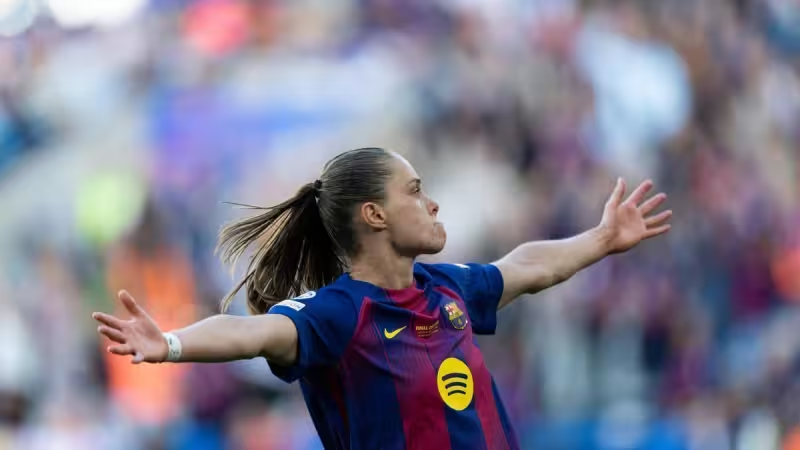
Ewa Pajor scored twice in Oslo to give FC Barcelona the UEFA Women's Champions League title, breaking a personal run of five final defeats and helping the club lift its fourth Champions League trophy in six years.
Pajor reached the final in Oslo having lost five previous Champions League finals; in her sixth appearance she produced a double that settled the match before Salma Paralluelo completed the victory and Barcelona staged jubilant celebrations on the pitch after the final whistle.
The scale of the win was plain in the numbers: Barcelona now have four Champions League crowns in six years, and Pajor finally erased the painful sequence that had seen five prior final losses. Players and staff poured onto the field in Oslo; Pajor, who said it was the best day of her life and thanked team and staff for the daily work that prepared them for this moment, was at the centre of the celebrations.
Homegrown identity mattered as much as the scoreline. Aitana Bonmatí stressed that the club’s talent factory endures, that players come and go but “the talent of the house” remains a constant that defines Barcelona. Caroline Graham Hansen, who grew up in Oslo, described the occasion as extra special — she said she knows every millimetre of that pitch and could not wait to take the squad out to celebrate with local fans — and reminded reporters that recent years had been hard financially, yet both the men’s and women’s sides managed to keep a top level.


That mix of continuity and strain is the story behind the trophy. Barcelona's reliance on youth products and a culture built around La Masia sits beside repeated warnings about limited resources; players such as Pajor and Paralluelo delivered on the field even as the club navigated financial headaches off it. Alexia Putellas, whose contract is ending, admitted the side had moments of doubt early in the season but always responded — a candid admission that underlined how fragile form and morale can be even in a champion dressing room.
The match also had a personal arc: Pajor, who had lost five previous finals, finally cleared that shadow in her sixth, underlining a career-long persistence that teammates hailed. Pajor thanked her colleagues and the coaching staff for pushing the group every day, and teammates reciprocated the emotion on the pitch as celebrations continued into the night.
There is a practical, club-level aftershock already forming. The victory reinforces Barcelona’s case for staying a continental power despite financial constraints and validates the La Masia pipeline that Bonmatí highlighted, but it also intensifies attention on squad decisions to come. For readers tracking the domestic calendar, the club’s next selection dilemmas are previewed elsewhere — see barca vs Alaves: Flick brings a 23‑man squad to Mendizorroza with hard choices — a reminder that league duties follow European glory.
The tension now is between the club’s sprint and its stamina: Barcelona are champions again, yet the season’s doubts, contract questions and economic limits have not vanished. The most consequential question left by the night in Oslo is whether Alexia Putellas, whose contract ends, will remain to help carry this La Masia‑built core forward — her decision will shape whether this era keeps its current shape or begins a new one.