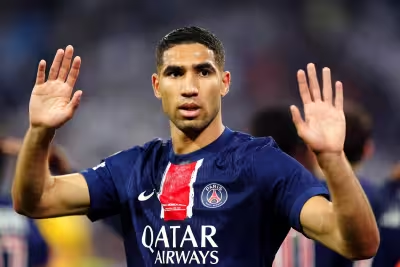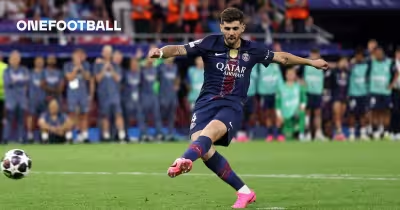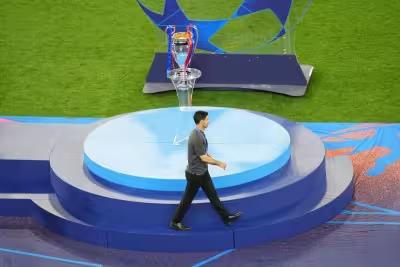




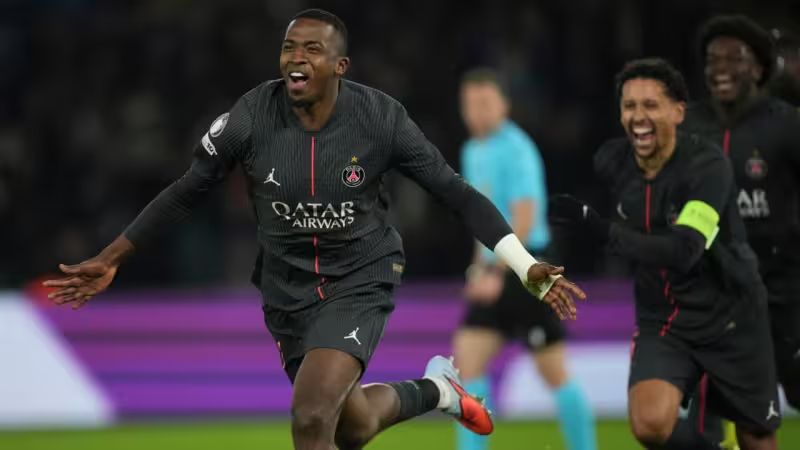
Willian Pacho will play his second consecutive Champions League final for PSG on Saturday, a match that hands the 24-year-old a starring role as Paris chases an uncommon back-to-back European triumph.
That is why the name willian pacho is trending today: PSG are the reigning European champions and could become only the second club since 1992 to retain the Champions League, and Pacho arrives at the final on the back of a man-of-the-match performance in the 2026 semi-finals.
Pacho’s path to this moment is stark and fast. Born into extreme poverty near Ecuador’s Pacific coast in the province of Esmeraldas, he played his first official matches for Huracan de Quininde before scouts from Independiente del Valle noticed him as a teenager. At 20 he moved to Royal Antwerp in Belgium, then signed for Frankfurt in the summer of 2023. PSG signed him in 2024 for €45 million, making him the first Ecuadorian in the club’s history.
Numbers matter here: 24 years old, €45 million, one man-of-the-match performance in the semis and now a second consecutive Champions League final. Pacho has become central to PSG’s rearguard and is candid about what drives him on the pitch. "I wore that number for a long time at Independiente del Valle and then at Royal Antwerp, and I became attached to it," he said of his squad number. He added, "But the main reason behind it is related to my mother, who passed away at the age of 51. Wearing that number is a way for me to pay tribute to her, and it gives me strength in every game." He has also credited his teammates: "Without this team, I wouldn’t be a great defender."

That bond with his club and the symbolism of the number 51 — the age at which his mother died and the number he kept at Independiente del Valle and Royal Antwerp — are part of why Pacho has become a focal point for PSG supporters. Coverage of his rise has tracked his milestones; for a look at his broader contribution this season see Round Time News’ features such as and the piece on his appearance milestones at
But the final is not a coronation. Arsenal arrive described as having one of the Champions League’s meanest defences, and that reputation directly complicates PSG’s title defence. Pacho’s recent form and physical presence bolster PSG’s chances of controlling Arsenal’s forwards, yet Arsenal’s compact, disciplined back line presents a different test: can a defender who rose from Quininde to Paris repeatedly reset and shut down a team defined by collective resilience?
The friction is clear on the pitch. PSG’s title defence depends on more than a single performance; it requires a defensive display that can neutralize Arsenal’s structure and still allow PSG’s attack room to operate. Pacho offers both the individual peak — his semi-final man-of-the-match display — and the story arc fans want: a player who used hardship as fuel to reach the highest stage. But Arsenal’s defence is not an opponent you simply overcome with momentum or narrative.
The most consequential unanswered question heading into Saturday is whether Pacho can translate his semi-final best into a repeat-level performance that contains Arsenal’s well-drilled back line and, in doing so, help PSG become only the second club since 1992 to retain the Champions League. The final will decide whether his journey from Esmeraldas to Paris leaves him lifting a second straight European crown — and whether the number 51 will have become a symbol not only of remembrance but of history.