




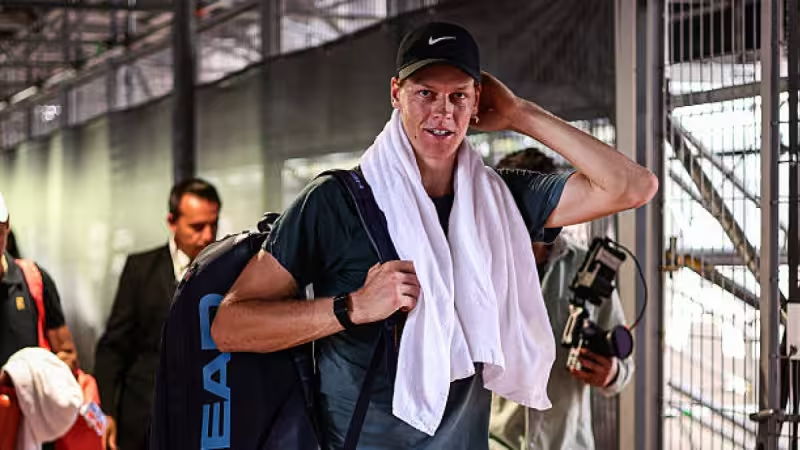
Jannik Sinner was informed he would likely face Elmer Moller in the third round of the 2026 Mutua Madrid Open if he wins his opening match.
The projected change matters because Moller did not arrive by ranking or seeding: he came through qualifying and advanced past Diallo 7-5, 3-3 when Diallo retired, replacing Diallo as Sinner’s probable opponent after earlier projections had pointed to Diallo based on ranking.
That result — a 7-5 set followed by a 3-3 scoreline ended by retirement — is the specific on-court event that moved Moller into the draw slot where he now stands to meet Sinner, altering a path that had been mapped out by ranking mathematics rather than by actual match outcomes.
On paper, jannik sinner’s route through the Madrid draw looked straightforward; in practice it has been revised by qualifying results and a mid-match retirement, the kind of Small event that reshapes what top players can expect to face in later rounds.


Separately, Sinner began his ATP Madrid event against Benjamin Bonzi, a fact noted in supplementary coverage that focuses on his opening match rather than on the identity of a third-round opponent. That angle does not change the primary point: Sinner will only meet Moller if he wins his debut match, and Moller reached the position through qualifying and a retirement.
The friction here is simple and technical. Tournament projections often use ranking to predict likely matchups two or three rounds ahead; those projections are useful until match play — and retirements — produce replacements that the bracket math did not account for. Moller’s path into the projected meeting spot exposes the gap between what brackets promise and what the court delivers.
Timeline matters: Moller advanced past Diallo with the 7-5, 3-3 scoreline finished by a retirement, and organizers informed Sinner that Moller was now the likeliest third-round opponent should Sinner win his opening contest. Because Moller came through qualifying, the encounter that loomed on paper as a ranking-versus-ranking matchup has become a clash with a qualifier whose route through the draw has already been unconventional.
That change has practical implications for scheduling and preparation: Sinner’s immediate task remains his opening match against Bonzi, but the scouting and mental preparation that would have targeted Diallo now point instead toward a player who earned his place via the qualifying rounds and whose progress included an opponent’s retirement.
What follows is straightforward: if Sinner wins his debut match, the bracket projects a third‑round meeting with Moller; if he does not, the projected clash will not occur. The clearest conclusion supported by the facts is this — Sinner’s Madrid path is now less predictable than earlier ranking-based projections suggested, because his likely third‑round opponent is a qualifier who reached that spot after a mid‑match retirement.