





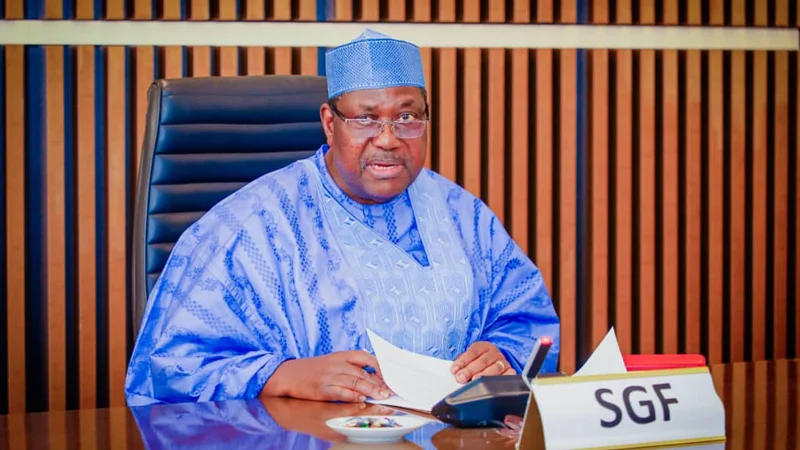
George Akume said on Tuesday that Atiku Abubakar was among the political leaders who backed rotational presidency after Nigeria’s June 12, 1993 election was annulled, placing one of the country’s most enduring power-sharing ideas in the middle of a fresh Democracy Day debate. Speaking in Abuja during a World Press Conference marking Nigeria’s 27th Democracy Day anniversary, the Secretary to the Government of the Federation said the agreement to alternate power between North and South came only after a hard political bargain.
Akume’s remarks matter now because they connect today’s arguments over zoning and equity to a moment many Nigerians still treat as foundational: the annulment of an election widely seen as decisive. He said Abiola won that vote and that the military government cancelled it, a decision he described as deeply painful because people had spoken freely and chosen their leader.


The SGF said leaders of the Peoples Democratic Party later gathered in Kaduna under the leadership of the late Chief Solomon Lar and Alhaji Adamu Ciroma, where the question of zoning the presidency between North and South was debated at length. In that meeting, he said, Atiku was one of the leaders present and part of the agreement that followed. Akume said the result was a compromise: presidential power would rotate, a formula meant to answer the divisions sharpened by the annulment and to keep the federation from tearing further along regional lines.
He did not describe what Atiku himself said at the Kaduna meeting, and no personal account from him was part of the public remarks Akume delivered. That gap is what gives the statement its edge: it turns a long-running political convention into a named memory, but it also leaves the record resting on one side of the story. What Akume did say was that the lesson of June 12 remains unchanged — the voice of the people must be supreme and sacrosanct, and Nigeria prefers the ballot to bullets.
By tying Atiku to the post-annulment bargain, Akume has reopened an old chapter in a new political season. The broader question now is not whether the rotational principle exists, but how much of Nigeria’s present power balance still traces back to the painful compromise struck after one of the darkest moments in the country’s democratic journey.