





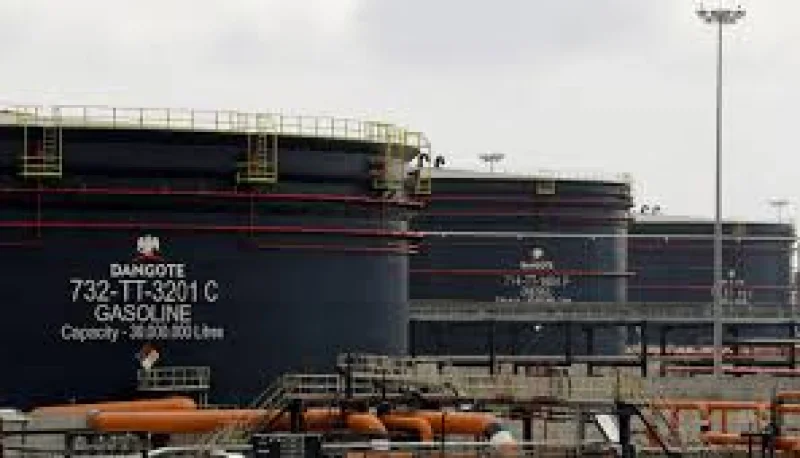
Standard Bank Group said Monday it will back the planned listing of the Dangote Petroleum Refinery and help finance future expansion projects after a strategic visit to the refinery and the Dangote Fertiliser complex in Lagos.
The visit put dangote back in the headlines: bankers, investors and policymakers are watching whether Africa’s biggest banking group will convert public support into a market-moving deal for one of the continent’s largest industrial projects.
Sim Tshabalala led the Standard Bank delegation and described the refinery as transformational for Nigeria and for Africa. Tshabalala said the institution is Africa’s largest bank, that it has a history of partnering with Dangote Industries Limited and that an initial public offering is coming up — a listing the bank intends to play a leading role in. He added that as Dangote expands, Standard Bank expects opportunities to provide financial advisory services and balance-sheet support across the continent.
Those public commitments were reinforced by executives who have watched the refinery rise. Devakumar Edwin said the bank had visited during construction and now, seeing the site in operation, could appreciate what its earlier support helped create. Edwin called the refinery "fully operational" and framed the visit as a milestone in a partnership that began years ago. David Bird echoed that sentiment, saying Standard Bank had been one of the refinery’s strongest backers throughout its history and that seeing the facility made the scale of the achievement clear.

Standard Bank also signalled a broader commercial programme: beyond advising on the IPO, the bank said it stands ready to finance further expansion projects as Dangote takes its industrial footprint deeper into Africa. That promise directly links the firm’s banking capacity with the refinery’s next growth steps and places the lender squarely in the centre of any future capital raise.
The contrast in Lagos is striking. Executives described the refinery as already affecting Nigeria’s foreign reserves, easing balance-of-payments pressure and changing daily life for ordinary Nigerians — outcomes that followed the plant reaching full output. Coverage of the refinery’s output has noted downstream effects, including recent fuel-price moves tied to increased local supply, such as cuts that put ex-depot petrol near ₦1,250 and diesel around ₦1,700 (see recent coverage at and
That operational reality sharpens a question Standard Bank’s statement left open. The bank pledged to back the planned IPO and to finance future projects, but offered no timetable, deal size or concrete underwriting commitment in Lagos. For investors and markets that need certainty, a public pledge that an IPO is "coming up" is not the same as a firm mandate, roadshow dates or an anchor-investor package.
The gap matters because the refinery is already being held up as a nation-level economic event. If the bank moves from public support to formal roles — bookrunner, lead adviser, or underwriter — it will change how the IPO is priced, how quickly it can be staged, and how much capital Dangote can tap for Vision 2030 ambitions. If it does not, the listing could be delayed while sponsorship and syndication are sorted.
What happens next is the key unresolved fact from Lagos: when will the IPO be launched and how large will the issuance be? Standard Bank has said it will be a leading player and that it stands ready with advisory and balance-sheet tools. The next concrete steps readers should watch are a timetable from Dangote Industries Limited, the naming of deal advisers and underwriters, and any regulatory filings that fix the size and structure of the offering.