




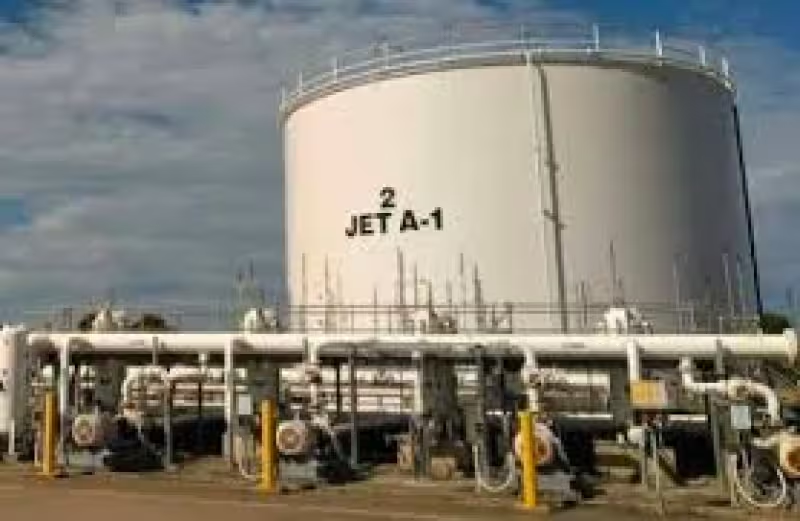
George Ene-Ita of the Nigerian Midstream and Downstream Petroleum Regulatory Authority said Dangote Petroleum Refinery will begin publishing aviation fuel prices daily, a move the regulator says will strengthen surveillance and ease cost pressures in the aviation sector.
"However, with particular emphasis on ATK, the Dangote refinery having released its latest indicative gantry prices, which they promised to publish daily going forward, will enable us ensure tacit compliance by marketers and operators during our routine surveillance operations nationwide," Ene-Ita said, adding that the disclosure is a concession designed "to help ease overhead cost pressures in the aviation sector in order not to truncate its operations."
The announcement comes as jet fuel costs have battered Nigerian carriers: airline operators said Jet A1 rose from N900 per litre on February 28 to N3,300 per litre, and the Airline Operators of Nigeria warned of losses exceeding N150bn in two months. That pressure prompted operators on April 14 to threaten a suspension of flights from April 20; the planned shutdown was later halted.
For immediate reference, Dangote Petroleum Refinery recently fixed its ex-gantry price for aviation fuel at N1,820 per litre, according to a news agency report. A federal government committee on April 27 said the indicative end-user price for aviation fuel should range between N1,760 and N1,988 per litre in Lagos and between N1,809 and N2,037 per litre in Abuja. The regulator said its pricing benchmarks are based on Platts averages recorded between April 17 and 23.
The disclosure matters today because Nigeria deregulated petroleum product prices; the regulator framed the refinery’s daily postings as an instrument to monitor the market rather than to set prices. Ene-Ita said the refinery's latest indicative gantry prices will help the regulator ensure tacit compliance by marketers and operators during routine surveillance operations nationwide, a response to opaque pricing that critics say has amplified the cost shock to airlines.
Dangote Petroleum Refinery has also moved into direct supply and export. Speaking at an energy conference in Lagos, David Bird said the refinery has begun direct aviation fuel deliveries to international carriers, including Ethiopian Airlines. "We’re proud to have done a direct delivery to Ethiopian Airlines, and we will continue to export surplus production to neighbouring African countries," Bird said, adding that the plant is operating at full capacity after earlier maintenance and that recent global oil prices had climbed to about $112 per barrel. "What is worse than $100 or $120 oil is no oil at all," he said.
Production figures give the regulator and the market a different kind of leverage. Devakumar Edwin said the refinery produces about 24 million litres of jet fuel daily, with a significant share exported to Europe, while Nigerian airlines' total demand is estimated at roughly 2.1 million litres per day. Since the onset of the Middle East crisis in late February, the refinery has supplied refined products to 11 African countries.
That scale is the source of the story’s tension. The NMDPRA notes prices are deregulated — publishing indicative gantry rates increases transparency but does not compel marketers to sell at those levels. Regulators say prices may still fluctuate because of global oil market volatility, including geopolitical tensions such as the U.S.–Iran situation, so disclosure can curb arbitrariness without guaranteeing price stability.
Airlines and ground handlers remain under strain. Roland Iyayi warned bluntly: "Airlines have bled over N150bn in two months. Where is the money going to come from? It’s gotten to a point where nobody can threaten anybody any longer." The chairman of the Aviation Ground Handling Association of Nigeria said the association is considering its next line of action. Olaniyi Adigun said: "What we intend to do is to come out with a press conference, and according to Nigerian law, we have our own strategy, which we are meeting together, and we are going to state our next move. Although some of them (airlines) have started, the majority have not. But that does not call off the strike," signaling labour options remain on the table.
Conclusion: Daily publication of dangote refinery jet fuel prices should reduce opacity and give the regulator measurable benchmarks to cite during inspections, and it may blunt some immediate cost-gouging. But with petroleum prices deregulated, global oil volatility and exporters' appetite to sell surplus abroad, the disclosure is better seen as a tool for monitoring and pressure relief than a fix for the systemic cost shock facing Nigerian aviation.