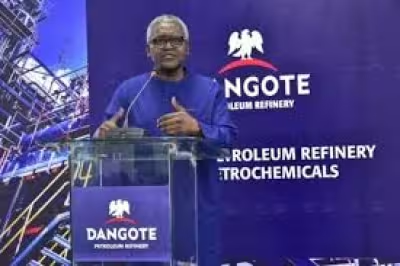




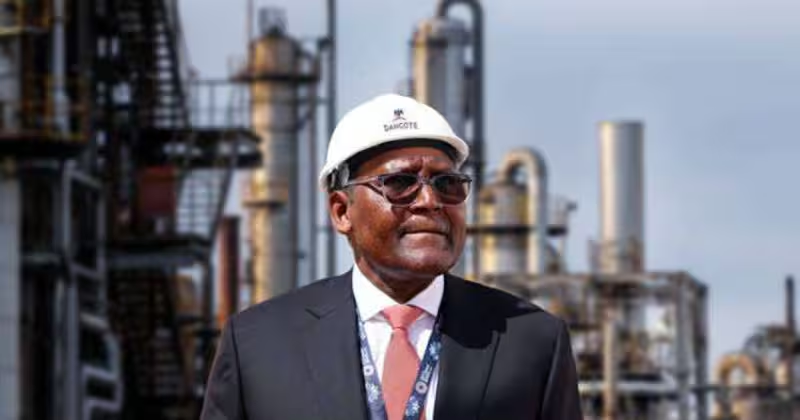
PenCom has relaxed its shares-investment rules so licensed pension fund administrators can take part in the planned initial public offering of Dangote Petroleum Refinery & Petrochemicals FZE, a circular obtained by TheCable shows.
Aliko Dangote, who has said Nigerians will be able to buy shares directly from the refinery, is now positioned to see a broad retail and institutional push into the business as the regulator temporarily set aside a key statutory hurdle.
The circular, sent to all licensed pension operators on Thursday and effective immediately, suspended Section 6.2.7.1 (iii) of the revised regulation on investment of pension fund assets to permit the participation. PenCom told PFAs the move followed a formal request and that the commission had reviewed that request in light of the refinery’s strategic and economic importance.
PenCom said it considered the refinery’s strategic importance, strong fundamentals and potential economic benefits before granting what it described as a special dispensation. The regulator removed the rule that ordinarily bars pension assets from being invested in ordinary shares of a company that has not posted taxable profits for at least three out of the previous five years and that has not paid dividends or issued bonus shares in at least one of those five years.
The commission waived the existence, profitability and dividend requirements for this IPO while stressing the waiver does not affect other regulatory safeguards. PFAs were instructed to ensure any investments under the dispensation comply with their own internal investment policies, risk management frameworks and their fiduciary duties to contributors and retirees.


PenCom emphasised the relief is exceptional and strictly case-specific to the Dangote refinery offering and said it should not be treated as an automatic precedent for future initial public offerings or other investment transactions. The circular made clear the move is a one-off regulatory forbearance targeted at the refinery’s planned sale.
The refinery’s plan to go public was first disclosed in May 2024, when company executives said the 650,000-barrel-per-day plant was aiming for a dual listing on the London Stock Exchange and the Nigerian Exchange Limited, with considerations for other African exchanges as well. Recent disclosures have suggested the company may sell between 5 percent and 10 percent of its stake and is targeting a valuation of about $50 billion, although no commencement date for the IPO has been announced.
In February 2026, Aliko Dangote said Nigerians would be able to purchase shares directly from the refinery, remarks that have figured in the pitch for broader domestic participation. PenCom said the expected economic impact of the proposed offering on the pension industry and the wider economy was a central consideration in its decision to grant the dispensation.
The tension in the decision is immediate and institutional. PenCom has temporarily removed a long-standing protective test designed to keep long-term retirement money out of companies without an established record of taxable profits and shareholder returns. At the same time, regulators and PFAs must weigh the promise of exposure to a potentially large national asset — one valued at up to $50 billion — against the risk that the refinery has not yet met ordinary profit-and-dividend tests that pension rules usually require.
What happens next is tightly scripted by the circular: PFAs can participate, but only under their internal rules and fiduciary duties, and they will do so against a backdrop of no announced IPO date. The commission’s insistence that the move is not a precedent leaves a narrow lane for future exceptions, meaning any other company seeking similar treatment will face its own, separate review.
For contributors and retirees, the practical consequence will depend on how individual PFAs interpret risk and opportunity. For the refinery and its backers, the dispensation clears a major potential source of domestic demand ahead of a sale of between 5 percent and 10 percent of the company. For Aliko Dangote, who has urged wider participation in the refinery’s shares, the relaxation is a regulatory green light to press that case — but one bound by the conditions PenCom has set.