



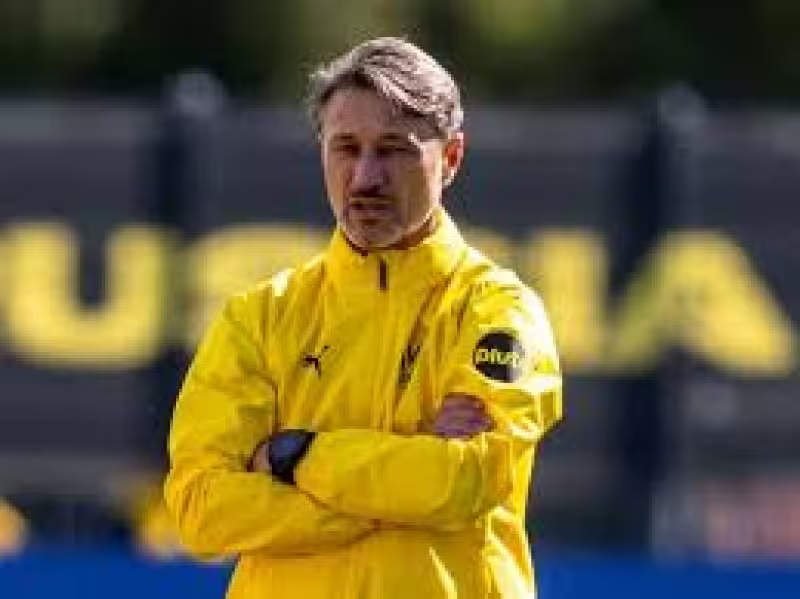
Borussia Dortmund hosted SC Freiburg at Signal Iduna Park on Sunday night, with manager Niko Kovac making four changes to his starting lineup ahead of a stretch of decisive fixtures.
The immediate stake was clear: Dortmund can officially guarantee Champions League football for next season with one more win, a reality that shaped Kovac’s selection in a match that followed successive Bundesliga defeats.
Kovac replaced Niklas Sule, Daniel Svensson, Carney Chukwuemeka and Fabio Silva with Ramy Bensebaini, Julian Brandt, Samuele Inacio and Serhou Guirassy, sending out a side in a 3-4-2-1 formation. Freiburg countered in a 4-2-3-1, with Julian Schuster making seven changes from their DFB-Pokal semi-final defeat to Stuttgart; Noah Atubolu, Lukas Kübler, Christian Günter, Bruno Ogbus, Nicolas Höfler, Derry Scherhant and Lucas Höler came into their starting XI.
The numbers underline why the fixture mattered on Sunday night. Dortmund entered the game on the back of back-to-back Bundesliga losses to Bayer Leverkusen and Hoffenheim — setbacks that were notable because the club had suffered only the same number of Bundesliga defeats across their prior 36 league matches as they did in those two consecutive reverse results. Those losses were particularly stark given that, as recently as Easter, Dortmund held an 11-point gap over the team in third place.



Injuries influenced Kovac’s thinking. Dortmund were without Karim Adeyemi because of a muscular injury and Emre Can because of a knee problem; Niklas Sule, himself managing a knee issue, was expected to return to the bench rather than start. Kovac’s four changes reflected both enforced absences and a push to steady the club after the twin reverses that narrowed a once-comfortable cushion toward the top of the table.
Freiburg arrived with their own immediate turbulence. They had been beaten in the DFB-Pokal semi-final by Stuttgart after extra time on Thursday, ending a run that had included four straight victories across all competitions beforehand. That cup exit was followed quickly by the need to prepare for a Europa League tie with Braga that begins away in Portugal next Thursday, a schedule that helps explain Schuster’s seven alterations.
The context here is straightforward: Dortmund’s brief wobble has cut into a commanding position they held at Easter, while Freiburg are balancing the psychological and physical demands of domestic and European commitments after a draining cup semifinal. Dortmund’s sporting director, Lars Ricken, has publicly challenged the club to play more attractive football and accelerate youth development, a pressure that sits behind Kovac’s team selections and the club’s wider response to recent results.
The tension is in the mismatch between the season’s arc and the current moment. A side that had been unusually durable across 36 games has suddenly collected two defeats in succession, and Kovac has been forced to rejig a lineup hampered by injuries. Freiburg, meanwhile, have the bite of a near-miss in the cup and the distraction — or opportunity — of a Europa League clash in Portugal next week; seven changes against Dortmund signal both rotation and recovery.
What matters next is simple and immediate: one more Dortmund victory would lock in Champions League football for next season. For Kovac, the selection choices he made on Sunday night and how the squad responds in the coming fixtures will determine whether that guarantee comes quickly or whether the club must face another run of results to secure its place. For Freiburg, recovery and rotation before the tie in Portugal will shape whether they can convert their recent form into a sustained push up the Bundesliga table; they sit seventh, with a one-point advantage over Eintracht Frankfurt.