




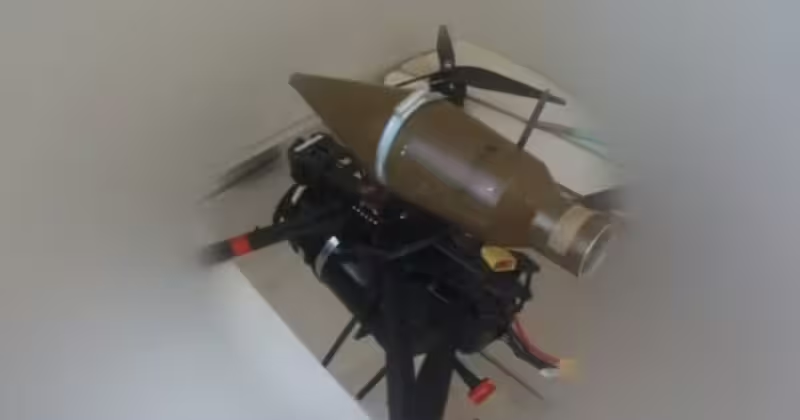
An explosive-laden fibre-optic drone slammed into an Israeli armoured unit in Taybeh, killing Idan Fooks and wounding six other soldiers, officers said. When a single Israeli medical evacuation helicopter arrived to pull casualties from the scene, Hezbollah launched two more tethered drones; one of those exploded metres from the aircraft.
The attack in Taybeh is the latest in a string of incidents that have put new technology directly into the path of Israeli soldiers. The aircraft used are lightweight, built from fibreglass, and run on a physical fibre optic cable that can extend between 10 and 30km. Operators guide the aircraft via high-resolution optical cameras that send uncompressed video back down the line, making the drones effectively invisible to electronic jamming and, officials say, nearly invisible to radar and thermal sensors.
Those characteristics have produced battlefield results. The tethered drones have bypassed the Trophy active protection system installed on Israeli Merkava tanks, and footage released after an earlier strike shows two FPV quadcopters with visible fibre-optic links striking an IDF Merkava tank at Mais al-Jabal on 15 April. Hezbollah later released material of the Mais al-Jabal strikes on 27 April, and a post on April 28, 2026 shared an image and description of the fibre-optic stealth FPV drone technology now being deployed.
The Taybeh strike killed Fooks and wounded six other soldiers, and it exposed a new tactical problem: the drones produce almost no thermal or radar signature and emit no radio signals, so Israel's early-warning systems — designed to detect radio-emitting drones and conventional aircraft — are effectively blind to them. The report says the drones are aimed at bypassing Israel's multibillion-dollar defence systems and that their manual steering, via live high-resolution video down a tether, gives operators direct control over precise strikes.
The results have left units on the ground scrambling. An Israeli commander currently in Lebanon acknowledged the difficulty plainly: "There isn’t much to do about it," he said. He described how briefings for troops have shifted to a blunt if inadequate set of instructions: "The briefing the forces get amounts to: ‘Be alert, and if you spot a drone, shoot at it’."
That combination of advanced, tethered guidance and near invisibility to sensors has led some Israeli combat units to try improvised defences of their own. Soldiers have begun suspending physical nets and other homemade barriers in hopes of catching or disrupting the fibre-optic drones before they can strike. Those ad hoc measures stand in sharp contrast to the complex, high-cost systems the drones were designed to defeat.
The tension between the technological leap embodied in the tethered FPV drones and the crude measures now being used to counter them is stark. On paper, multibillion-dollar active-protection and early-warning networks should protect armoured formations and airborne medevac operations. On the ground in Taybeh, a medevac helicopter came under near-miss conditions when a secondary drone detonated metres away — a reminder that evacuation itself can become a target in the new dynamic.
Hezbollah's public posts and the strikes themselves make clear the capability is replicable at range and under control: fibre-optic links measured in tens of kilometres, fibreglass airframes that leave almost no heat or radar return, and manual video control that bypasses electronic warfare. The most consequential outcome so far is tactical: units can no longer rely on distant sensors and automated active protection alone; soldiers must change how they move, evacuate and protect vehicles at the level of ropes and nets.
That shift matters because it rewrites where the risk sits. Instead of threats being detected and defeated by sophisticated systems before they reach troops, soldiers now face weapons that arrive unseen and up close. Hezbollah's fibre-optic FPV drones have forced Israeli forces to trade automated protection for improvised, human-scale defences — and, after Taybeh, that trade has cost lives.