




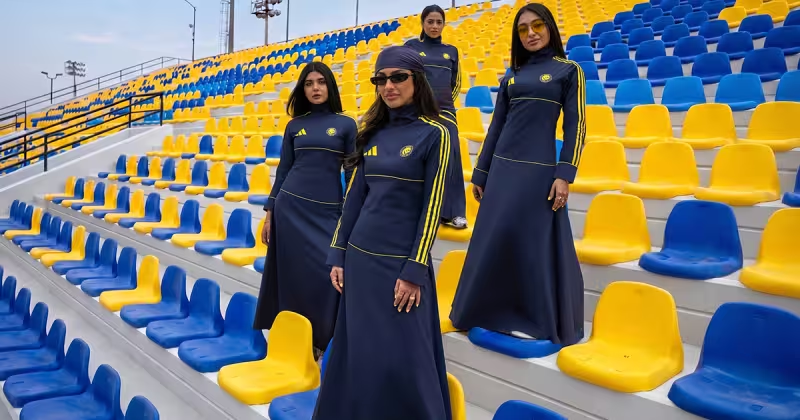
On April 29 in Riyadh, a number of women at Al Nassr FC's home fixture turned heads not with scarves but with custom-designed dresses by Saudi designer Nora Al Shaikh.
The garments used modest proportions and understated references to the club. The dresses were produced as a one-off and were not intended for retail, Al Shaikh said, and a supplementary article said the pieces were limited to 100, designed in collaboration with Adidas and given directly to fans at the match between Al-Nassr Football Club and Al-Ahli.
Al Shaikh said she began from what she had seen in the stands. "As football continues to grow in Saudi, I was seeing more women fully immersed in the stands, the atmosphere, and the wider football culture," she said. "Their presence was mostly expressed with props like flags or scarves. There wasn’t actual fanwear designed for how they could dress. That stayed with me."
That observation guided the look. "I wasn’t looking to replicate traditional football jerseys, but to reinterpret them…" Al Shaikh said. She described the starting point as the women who would wear the clothes. "The starting point for me was always the women themselves… Saudi women aren’t a single, uniform group," she said.



The visible detail on the dresses was small: color nods, subtle piping, and proportion choices that read as fanwear without copying a jersey. The primary goal, Al Shaikh said, was cultural rather than commercial. "The intention was to create something meaningful… For now, it’s about starting a conversation," she said.
The timing matters because it arrives as stadium culture in Saudi is changing. Big-name signings and new competitions have brought more attention to local clubs; stars on the field draw new kinds of spectators — Cristiano Ronaldo has scored five direct free-kick goals for Al-Nassr, a figure that speaks to the club’s global visibility. The dresses are a reminder that the audience for that attention is shifting as well.
There is a tension between the designer’s stated aim and the scale of the effort. On one hand, the primary account says the dress was a one-off and not intended for retail. On the other, the supplementary article reports a 100-piece run handed directly to fans and an Adidas collaboration. The gap raises the question of whether the dresses were a prototype meant to spark discussion or the opening of a limited campaign — the articles do not resolve that.
For now, the effect was immediate at the match: women appeared in coordinated outfits that read as designed for the stadium in a way flags and scarves had not. Al Shaikh recalled attending games and noticing a contrast: "I was at one of the Al-Nassr games… The men had fanwear jerseys, but the women didn’t." The dresses at Riyadh were a direct response to that absence.
The dresses do not answer whether tailored fanwear for women will become widely available, nor whether larger apparel partners will move beyond small runs. They do make clear that women in Saudi are already changing what it looks like to be a football fan. Al Shaikh’s modest project at a single April 29 match may be small in scale, but it is deliberately meant to begin a conversation about who fan culture is designed for — and how it might change next.