



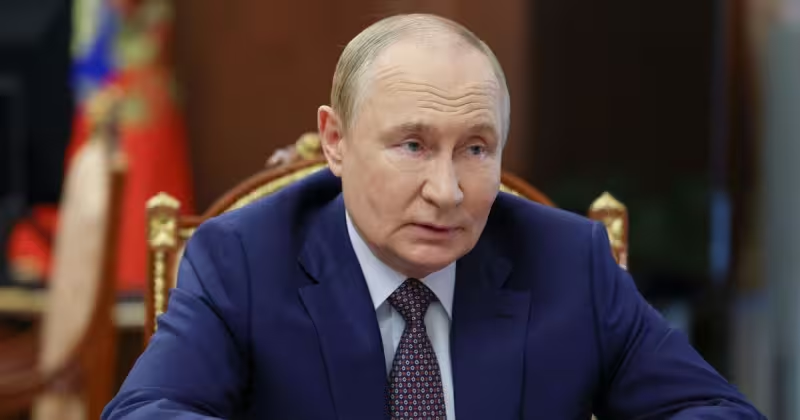
Vladimir Putin has ordered a sweeping security clampdown and increasingly worked from renovated bunkers in the Krasnodar region since the beginning of March 2026, according to a report by Important Stories that cites an unnamed Western intelligence agency.
The report says the Kremlin is acting on two linked fears: a leak of sensitive information and the risk of a plot or coup attempt within the Russian political elite. In response the Federal Protective Service has significantly tightened security measures around the president, cutting the list of places he visits, halting his visits to military infrastructure this year and imposing two levels of screening on visitors to the Presidential Administration, including full body searches by FSO officers.
The clampdown has practical, visible effects: neither he nor his family reportedly visit their usual residences in the Moscow region—Novo-Ogaryovo and Valdai—anymore, and mobile internet is frequently cut off in Moscow as a security measure. The report says the FSO now conducts large-scale checks with canine units and has deployed officers along the Moscow River to respond to possible drone attacks. It adds that Putin may work for weeks at a time from renovated bunkers in Krasnodar while Russian media maintain public communication by using pre-recorded footage.
Important Stories links the security escalation to concrete personnel moves inside the Kremlin. Sergei Shoigu, who serves as Security Council Secretary, is named in the report as associated with the risk of a coup attempt. The arrest last month of Ruslan Tsalikov on suspicion of corruptly amassing almost £50 million in family assets is also presented as part of the environment of mistrust that has gripped the administration since March.
Those numbers and measures give the Kremlin’s reaction weight: full body searches at the Presidential Administration, reduced travel routes, halted military visits, and a shift to bunker-based working are not routine precautions. The Important Stories account says these steps reflect a leadership that now doubts the loyalty of parts of its own elite and is preparing — at least defensively — against drone strikes and internal plots.
Context matters: the report relies on Important Stories and an unnamed Western intelligence agency and places the moves in the wider setting of the war in Ukraine. Since the beginning of that war, the presidency has increasingly used renovated bunkers, and Krasnodar—where the report says Putin may spend weeks at a time—has itself been repeatedly targeted by Ukrainian drones. That pattern helps explain why the Kremlin would prefer remote, hardened locations and tighter control of movement and communications.
There is a sharp tension between the Kremlin’s heightened secrecy and the mechanics of governing and public messaging. The report says Putin’s normal public relations team has been sidelined, and that security operatives now approve Russian media reports about him following a secret presidential decree. At the same time, the apparent sidelining of conventional advisers and the focusing of power inside a small security apparatus raise the risk that information will flow poorly and decisions will be made on the basis of containment rather than strategy.
Another friction: the report flags both external and internal threats at once. FSO deployments against drones and the repeated cutting of mobile internet in Moscow answer an external threat; naming a senior official such as Sergei Shoigu in association with a coup risk points to internal fractures. The arrest of Tsalikov last month, tied to almost £50 million in alleged corrupt assets, adds the suggestion of a purge or a search for scapegoats—but the report does not say whether those moves are coordinated, preventative or reactive.
The single most consequential unanswered question now is whether the Kremlin’s security measures will stabilize the president’s hold on power or deepen the very isolation and elite infighting that the measures aim to prevent. The Important Stories report makes clear that, since the beginning of March 2026, the Kremlin has judged the danger real enough to change where Putin works, who can approach him and how the state tells his story—but it offers no answer to whether those steps will be enough.