



On 3 May 2026, during FC Porto's title celebrations at the Estádio do Dragão, Thiago Silva stood before supporters and took them back to his first appearance in a Porto shirt: a January Taça de Portugal quarter-final against Benfica that Porto won 1-0.
Silva, 41, told the crowd he had only recently arrived in the city, spent six days at a training camp in the Algarve with his new teammates, and then made his debut in that knockout cup tie. He recounted the moment plainly: "Vim para o Porto, fomos para o Algarve (estágio) para ficar seis dias, fiz treino com a equipa e fiz a estreia contra o Benfica. Eu realmente tinha medo, aquele friozinho na barriga. Eu questionava: 'Será que estou preparado?', não fiz nada demais."
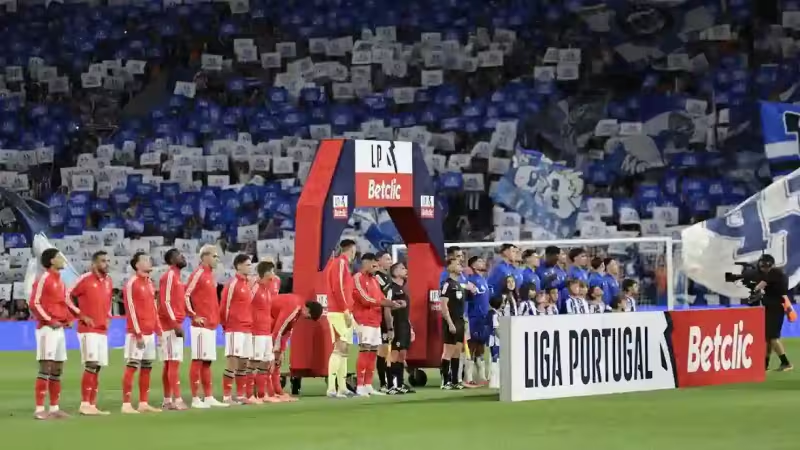
The match itself carried weight on the pitch and in the record books. Silva was named in the starting lineup alongside Jan Bednarek as Porto edged Benfica 1-0 at the Dragão, a result that eliminated Benfica from the competition.
That elimination matters: Benfica has lifted the Taça de Portugal more than any other club, with 26 titles. Losing in the quarter-finals to a newly integrated veteran such as Silva was a shock against that backdrop and a headline moment in Porto's cup run.



Silva's recollection contained an obvious tension. He admitted real nerves before the game and questioned his readiness, yet the facts of the night were simple — he started, Porto won, and Benfica, the competition's standard-bearer, were knocked out. The contrast between doubt and outcome is the friction that made his comments notable during the celebrations.
He explained how he closed that gap between uncertainty and performance. Speaking of his on-field approach, Silva said his experience was decisive: "A experiência deu-me condições de jogar um jogo de alto nível de uma maneira inteligentíssima, marcando jogadores incríveis do Benfica de uma maneira eficaz." In other words, he credited years of top-level play with letting him manage a high-intensity match intelligently rather than through raw athleticism alone.
That claim is concrete in the limited facts he offered. At 41, Silva was not a peripheral substitute on that January night; he was a starter in a cup quarter-final who helped preserve a clean sheet and secure a 1-0 win that sent Benfica out of the tournament. Porto's celebrations in May framed his memory of the night as part of the club's season story: a veteran arriving, integrating quickly after a short Algarve camp, and contributing when it counted.
Silva's admission of fear followed immediately by an assertion that experience delivered an "intelligent" high-level performance is both the human detail and the headline judgment of his remarks. It is what supporters will remember from the Dragão speech: a player who felt raw nerves before his debut but who, by his own account, used decades of experience to mark elite opponents effectively and help his team advance.