


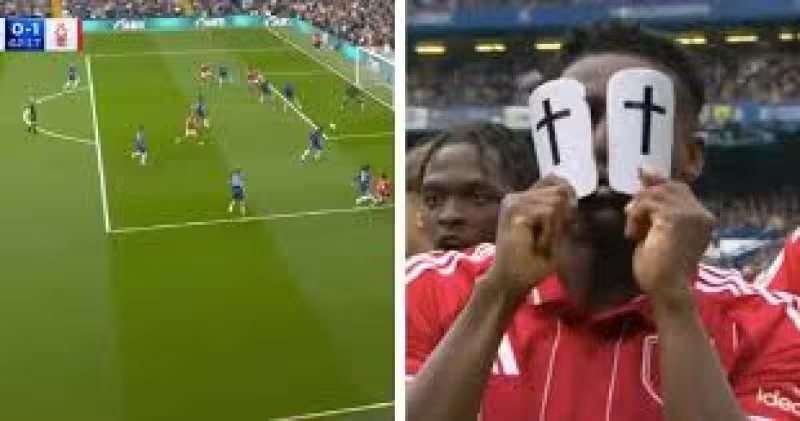
Taiwo Awoniyi headed Nottingham Forest into the lead at Stamford Bridge after barely 90 seconds, the striker meeting an uncontested cross from Dilane Bakwa to put Forest ahead in the Premier League clash.
The quick opener set the tone. A couple of minutes later, as Bakwa swung another cross into the box, Chelsea right-back Malo Gusto pulled at Awoniyi's shirt while the striker tried to get on the end of it; referee Anthony Taylor did not spot the foul at first, but a VAR review changed everything. "After review, Chelsea number 27 deliberately pulls his opponent, therefore my final decision is penalty kick and yellow card," Taylor said, and Igor Jesus converted the spot-kick to make it 2-0 inside the first 17 first half minutes.
The match feed on X made the sequence plain: "#CHENFO – 12’ VAR OVERTURN After VAR review, the referee overturned the original decision of no penalty to Nottingham Forest." The rapid two-goal swing — the opening strike coming after roughly two minutes and the penalty decision confirmed shortly after — left Chelsea scrambling and Forest in full control.
Those numbers matter now. Chelsea were 2-0 down after 17 first half minutes; Forest’s opener came at about the 90-second mark; and the referee’s reversal arrived at 12’ on the official match timeline. The two-goal cushion gave Nottingham Forest a platform from which they could manage the remainder of the game, while Chelsea faced the immediate task of steadying a defence that conceded twice almost as soon as the contest began.
Context sharpens the picture. Chelsea arrived at Stamford Bridge needing a win to keep faint top-six hopes alive and battling a run of poor form that had seen them lose five Premier League matches in a row without scoring. They also had not kept a clean sheet in 13 Premier League games, a run that left this kind of early collapse particularly damaging to their season objectives.
The friction in the story is simple: the incident was not obvious to the match official on the pitch, and it took VAR to bring it to light. That difference — what the referee saw in real time and what the video angle revealed — decided an early game-changing decision. Broadcast reaction was immediate, with commentators arguing the pull was a clear penalty and criticizing the defender for an avoidable foul that left his side exposed.
On the pitch, the sequence was plain enough: Bakwa’s cross was easy to reach, Awoniyi’s header was straightforward past Robert Sanchez, and the tug that followed was enough for the video referee to insist on punishment. The reversal — from no penalty to a spot-kick and a booking for Gusto — compressed several pivotal moments into a handful of minutes and swung the momentum to Forest.
For Chelsea, the consequences are immediate. Falling behind so quickly removed any luxury of a slow restart; the team had to chase the game while trying to stop a run of results and performances that had already damaged their league hopes. For Nottingham Forest, the early goal and the penalty award underlined a capacity to seize the moment and force a fragile opponent into errors.
The clearest conclusion is that a match at Stamford Bridge turned on two brief actions in the opening quarter: an uncontested cross met by Taiwo Awoniyi, and a shirt tug that VAR judged worthy of a penalty. Those two acts — one decisive finish, one punished foul — reshaped the contest within 17 first half minutes and left Chelsea with an urgent question about how they steady a side that can be undone so rapidly.