




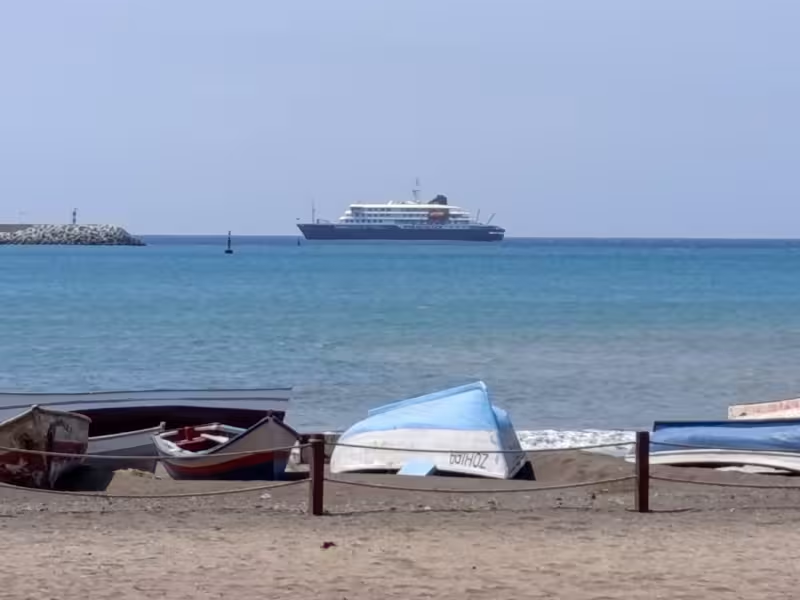
Late Tuesday Spain granted permission for the Dutch-flagged MV Hondius to sail to the Canary Islands after the vessel was hit by a cruise ship hantavirus outbreak that has killed passengers and forced medical evacuations, the Spanish Ministry of Health said.
The move follows two deaths in early April — a Dutch couple and a German national — and further medical needs among the 147 people on board: 88 passengers and 59 crew members from 23 countries, the World Health Organization said. Oceanwide Expeditions, the ship’s operator, reported that two crew members required urgent medical care. On Wednesday morning three people were evacuated from the ship in Cape Verde; they were from Britain, Germany and the Netherlands. A British doctor who had been critical was evacuated and was later reported in stable condition by the Spanish health minister.
Spain’s Ministry of Health said, "The Canary Islands are the closest location with the necessary capabilities," and added that "Spain has a moral and legal obligation to assist these people, among whom are also several Spanish citizens." The ministry said the MV Hondius was expected to dock in either Gran Canaria or Tenerife after three days of sailing and that Spaniards would be sent to quarantine in Madrid while non-Spaniards without symptoms would be sent home.
The government said the crew and passengers would be examined, treated and repatriated in coordination with the European Centre for Disease Prevention and Control and the World Health Organization. Medical care and transportation would be provided "in special facilities and vehicles to avoid contact with the local population and protect health workers," the ministry said.
WHO technical lead Maria Van Kerkhove, speaking about the agency’s work with the ship and affected countries, warned there are complicating factors aboard: "We do believe that there may be some human-to-human transmission that’s happening among the really close contacts, the husband and wife, people who have shared cabins." She added, "We just want you to know we are working with the ship’s operators" and "We are working with the countries where you are from. We hear you. We know that you are scared." The WHO has also said the risk to the wider public is low and that authorities were told there were no rats on board the vessel.
The MV Hondius left Ushuaia, Argentina, on April 1 bound for Cape Verde when the outbreak was detected. Officials say the hantavirus strain implicated is rodent-spread and that person-to-person transmission is rare, but the deaths and the pattern of close-contact illness on a confined expedition vessel prompted the urgent diplomatic and public-health response.
The clearest weight to the decision to allow the ship to continue to the Canaries is the number of people involved and the need for a place able to receive, isolate and care for them: 147 crew and passengers from 23 countries, two crew in urgent need and three evacuated in Cape Verde in a single morning. That density of potential exposures — including shared cabins and couples — is precisely why Spanish authorities framed the Canary Islands as both logistically the closest option and a legal duty to assist, and why the WHO is deploying technical support.
Still, the plan has built-in friction. Local leaders in the Canary Islands voiced opposition to a docking plan even as Madrid and national health officials called it safe; the ship’s voyage several days from Cape Verde to Gran Canaria or Tenerife creates a narrow window for more cases to appear or for close-contact transmission to become evident. Authorities also face the practical knot of repatriating citizens from 23 countries while preventing secondary spread: some passengers will be quarantined in Madrid and others sent home if symptom-free, all after being transported in special vehicles.
The most consequential question now is operational: can Spain and its international partners examine, isolate and move the 147 people aboard the MV Hondius without generating new transmissions among close contacts during the three-day transit and the repatriation process? The answer will determine whether the outbreak aboard this expedition vessel remains an isolated maritime incident or becomes the start of broader chains of infection among family members and travel contacts back home.