




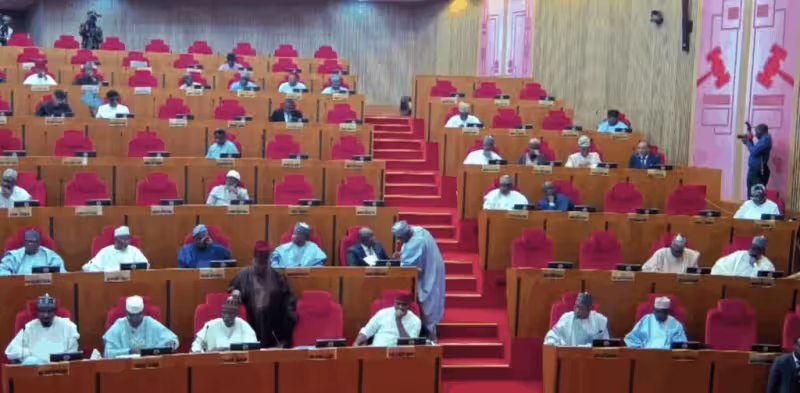
The Senate on Thursday approved an amendment to the Electoral Act, 2026 that designates which courts will hear pre-election disputes, a move senators say will stop forum shopping and prevent contradictory judgments in candidate nomination fights.
Senator Simon Lalong, sponsor of the bill and chairman of the Senate committee on electoral matters, told colleagues the measure proposes changes to section 29 and introduces a new section 29A to establish definitive jurisdictional competence in pre-election matters.
Under the amendment approved on Thursday, all pre-election disputes arising from National Assembly, State House of Assembly, governorship and deputy governorship contests will originate at the Federal High Court, with appeals heard by the Court of Appeal. Matters involving the presidency and vice-presidency will commence at the Court of Appeal and terminate at the Supreme Court, the Senate agreed.
Lalong said the legislation also amends section 29 to allow aspirants to institute actions either in the Federal Capital Territory or in the jurisdiction where the cause of action arose, and that the new section 29A clarifies the broader allocation of pre-election suits.
"Democracy thrives not merely on the conduct of elections, but also on the credibility, certainty, and predictability of the legal process that precedes the post-election," Lalong said during floor debate. He described the amendment as designed to "eliminate conflicting judgements, reduce abuse of judicial processes and shorten delays in the determination of electoral disputes."

Lawmakers said the change would also reinforce timelines for the Independent National Electoral Commission to finalise candidate lists, and generally ensure the legal status of candidates is settled before the general election.
The amendment, the first major adjustment to the Electoral Act, 2026 since President Bola Tinubu signed the law on February 18, responds to senators' concern that judicial ambiguities have produced inconsistent rulings and prolonged litigation over nominations.
Senators argued the Act focused earlier on technical aspects of voting and results transmission, and that pre-election adjudication remained a weak link: "Where the legal framework regulating the pre-election dispute is uncertain or conflicting, the entire electoral architecture becomes vulnerable to confusion, forum shopping, contradictory judgments, and unnecessary delays," Lalong said.
The bill seeks to curb forum shopping in internal party disputes by designating specific courts to handle pre-election matters and by preventing contradictory judgments from courts of coordinate jurisdiction. Lalong added that the amendment "reduces hardship on litigants, improves access to justice and aligns electoral adjudication with territorial realities surrounding political primaries and nomination processes."
There is, however, an internal tension in the package: while section 29A funnels most pre-election suits to the Federal High Court, the change to section 29 preserves a choice for aspirants to sue in the Federal Capital Territory or where the cause of action arose — a feature critics could argue still leaves room for strategic filing choices.
Parliament scaled the bill through second and third readings on Thursday and approved the proposed sections and related jurisdictional changes. If the measures work as sponsors intend, they will shorten delays in nomination disputes and help restore public confidence in electoral adjudication, Lalong said: "This amendment is both practical and equitable."