




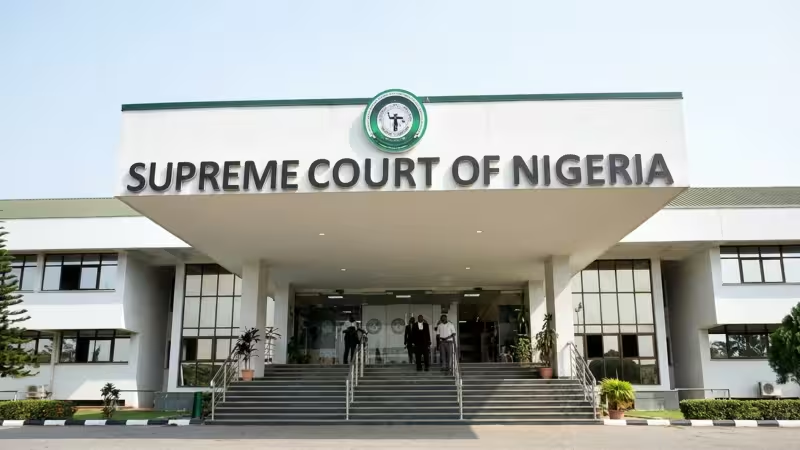
The Supreme Court will deliver judgment at 2:00 p.m. Wednesday, April 30, 2026, in two high-stakes party leadership appeals — one over the African Democratic Congress and the other over the Peoples Democratic Party — a ruling that party leader David Mark and rival factions say will decide who appears on next year’s ballots.
The five-member panel, headed by Justice Mohammed Garba, concluded hearings on both disputes on April 22 and reserved judgment; the court listed the ADC matter as SC/CV/180/2026 and the PDP matter as SC/CV/166/2026. ADC figures have been holding emergency meetings ahead of the ruling: Imran Wakili said, "ADC leaders are currently in an emergency strategic meeting ahead of tomorrow’s Supreme Court ruling on the party’s leadership tussle" and that the meeting is "expected to review possible outcomes of the judgment and the next line of action for the opposition coalition which has adopted the ADC as its major political platform ahead of 2027."
The ADC case pits factions aligned with former Senate President David Mark against a rival group led by Nafiu Bala Gombe over who is the party’s national leadership. Mark has urged the court to overturn earlier decisions that allowed a suit challenging the party’s leadership to proceed; his counsel, Jibrin Okutepa, told the court that judges lack jurisdiction over internal party matters and cited a March 21, 2025, Supreme Court decision holding such disputes fall outside judicial authority.
That jurisdictional argument faces headwinds from a Court of Appeal ruling that described Mark’s appeal as premature and filed without leave, ordered the case returned to trial and directed the parties to maintain the status quo ante bellum. INEC has at times withdrawn recognition of the Mark-led leadership pending resolution; a Federal High Court also restrained INEC from recognising ADC congresses conducted by the Mark leadership and halted those caretaker congresses while affirming the tenure of state executives.
Shaibu Aruwa, pressing for speed, warned of the consequences in a letter to the chief justice on April 22, saying the delay posed a "grave and irreversible risk" and arguing, "My Lord, the ADC’s ability to comply with these statutory requirements to participate in the 2027 General Elections is wholly dependent on the timely delivery of the judgment in the instant appeal." Aruwa added that delay could "deny them their constitutional right to freely associate and contest elections through a political party of their choice."
Mark has sought to reassure supporters. "You do not have anything to be afraid of regarding all the litigations before the party," he told members, adding, "I want to assure you that we shall triumph in all the cases, and we shall be on the ballot for every election." He said the party’s legal team had begun appealing a Federal High Court judgment and had applied for a stay of execution. Support for the court challenge is split inside the ADC: Dumebi Kachikwu and state chairmen backed the judicial route and warned they would not allow the party to be hijacked.
The PDP appeal revolves around a disputed national convention held in Ibadan, Oyo State. A faction led by Taminu Turaki has asked the apex court to overturn a Court of Appeal judgment that nullified the convention for violating a subsisting court order and to dismiss a cross-appeal by a rival faction aligned with Nyesom Wike. The court’s decision in the PDP case could reshape the recognized leadership of one of the country’s largest parties.
The friction at the heart of both cases is legal as much as practical: the ADC arguments ask the Supreme Court to revisit or distinguish its March 21, 2025, precedent that placed internal party disputes largely outside judicial reach. The appellants counter that conflicting lower-court orders and INEC’s oscillating recognitions have created real, immediate harm to parties’ ability to prepare for the 2027 general elections.
The single most consequential question now is whether the court will maintain its earlier restraint on intraparty disputes or carve out an exception that would allow judges to pick between rival party leaderships — a decision that will, in effect, determine which factions can put candidates on the ballot in 2027. The answer at 2:00 p.m. on Wednesday will not only resolve two legal fights; it will decide who speaks for two major parties as the country enters a pivotal election year.