



The Federal Reserve held U.S. interest rates at a range of 3.5% to 3.75% today, marking the third consecutive meeting in which officials left the central bank’s key lending rate unchanged.
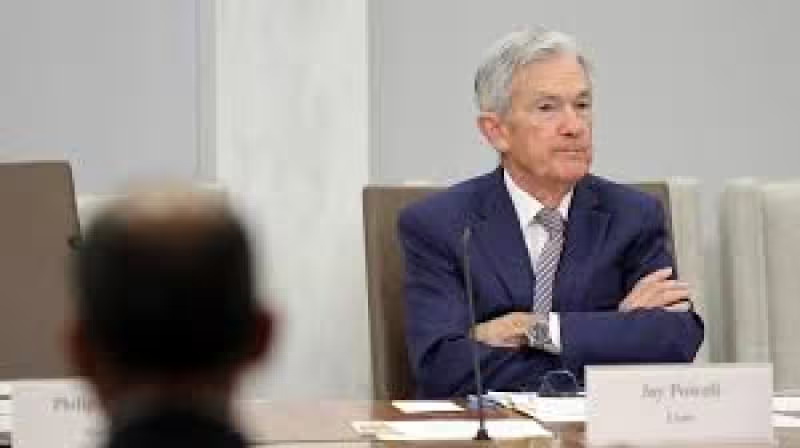
Jerome Powell, who is expected to deliver remarks 30 minutes after the announcement, presided over a decision that revealed sharp internal divisions: four of the Federal Reserve’s governors dissented against the decision, the first time that number has opposed an ultimate Fed action since October 1992.
Markets had widely expected no change to policy at this meeting, and the Fed confirmed its next policy gathering will take place in June. The bank’s statement included language describing an "easing bias," language that three other governors explicitly opposed.
Those objections went beyond phrasing. Stephen Miran wanted the bank to cut interest rates by 0.25 percentage points, underscoring a split over whether policy should be loosened even as headline inflation sits at 3.3% for March — the highest rate since May 2024.

The broader economic picture the Fed faces is unusually contingent on an external shock. The prospect of any rate cuts this year, the statement said, depends largely on the conflict in Iran. That conflict has shut down the Strait of Hormuz and pushed up global energy prices, complicating the central bank’s path toward easier policy.
The disagreements were visible in the margins of a decision that, on paper, met market expectations. Four governors formally dissented and three opposed the specific declaration of an "easing bias," a configuration that signals meaningful caution inside the Fed even as officials hold rates steady. The split is the clearest evidence yet that policymakers are not united on how quickly — or whether — to loosen policy in the months ahead.
Powell’s role in the moment is also notable. Nominated by President Donald Trump in 2017, Powell is expected to make these remarks amid what officials and observers view as likely his last meeting as Fed chair. He is set to be replaced by Trump’s pick, Kevin Warsh, if Warsh is confirmed by the full Senate.
Traders and fixed-income desks had priced in no change, and the unchanged rate alongside the publicized dissents will reshuffle expectations about the timing and size of any future cuts. For many market participants — from institutional traders to those who follow calendars and commentary on sites such as forex factory — the near-term question is whether geopolitical developments will give the Fed cover to pivot or force it to stay the course.
The most consequential unanswered question is now explicitly political as well as economic: will the Senate confirm Kevin Warsh to succeed Powell, and if so, will a new chair alter the Fed’s trajectory on cuts amid a disrupted energy market? The answer will determine whether today’s pause becomes the start of a gradual easing or a prolonged holding pattern driven by external conflict and internal disagreement.