



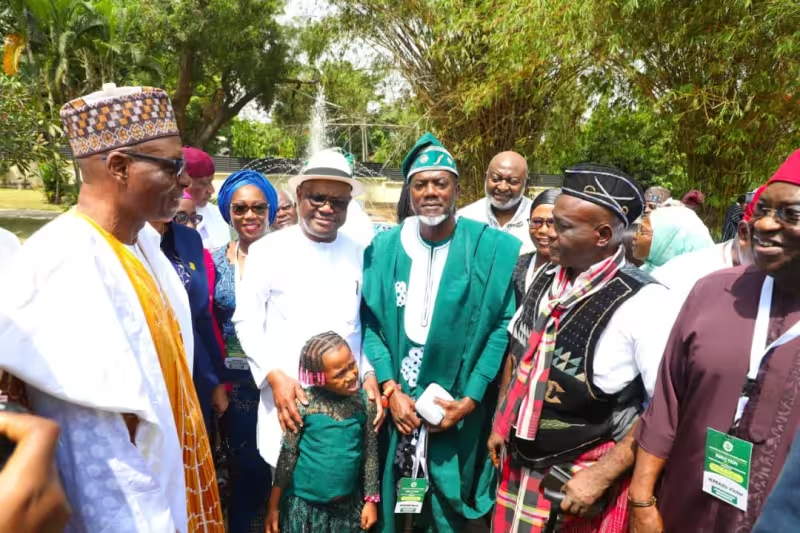
President Bola Tinubu has approved the allocation of plots of land in Abuja for Nigerian ambassadors and high commissioners-designate, a move disclosed on Wednesday by the Federal Capital Territory minister, Nyesom Wike, as the new envoys were hosted at his residence in Life Camp. Wike told the diplomats to collect application forms for land allocation before leaving the meeting, saying the president wanted them to have a permanent foothold in the capital for periodic briefings.
The announcement came as the delegation, led by the Permanent Secretary of the Ministry of Foreign Affairs, Dunoma Umar Ahmed, continued an induction programme for newly appointed diplomats in the administrative and diplomatic nerve centre of Nigeria. Tinubu had opened the course in Abuja on Monday and urged the ambassadors to aggressively pursue foreign investments, strengthen strategic partnerships and reposition Nigeria in global affairs.
Wike framed the land plan as part of a wider push to make the envoys active partners in economic diplomacy. He said they are “the mirror of this country,” and that the way the world sees them is the way it will see Nigeria. He also said Tinubu had travelled widely to attract investment and partnerships, and that it was now the diplomats’ job to reinforce that effort by building confidence in Nigeria as a viable destination for investment.
The FCT minister used the meeting to pitch Abuja itself as part of the message. He pointed to infrastructure expansion across the six area councils of Abaji, AMAC, Bwari, Gwagwalada, Kuje and Kwali, and urged the envoys to bring investors into agriculture and waste management. He said arable land in Gwagwalada and Kwali remained largely untapped, and added that Nigeria was already engaging Saudi Arabia and Egypt on key sectors while planning talks with the European Commission on development cooperation.


Wike also told the diplomats that Nigeria remains a multi-party democracy and that there is no plan to turn the country into a one-party state, a political reassurance delivered alongside the economic pitch. His confidence was broad enough to stretch to 2027, when he said he expects the country to be “more peaceful, more united, and stronger as a nation.”
The land allocation pledge lands in the middle of a wider diplomatic reset that has moved quickly in recent weeks. On November 29, 2025, Tinubu sent 32 ambassadorial nominees to the senate for confirmation, including Reno Omokri, Mahmood Yakubu and Femi Fani-Kayode, and days earlier asked lawmakers to confirm three non-career ambassadors: Kayode Are, Aminu Dalhatu and Ayodele Oke. The senate later confirmed 64 ambassadorial nominees on December 18, 2025, split between 34 career ambassadors and 30 non-career envoys.
Tinubu has argued that the appointments reflect confidence in the envoys’ ability to advance Nigeria’s interests abroad, but he has also warned that the external environment is becoming harder to manage. On Monday, he said the international system is being reshaped by geopolitical shifts, economic uncertainty, technological disruption, climate pressures and new security threats, and pressed the diplomats to use modern tools, digital engagement and strategic communication. He also said protecting Nigerians in the diaspora must remain a top priority, and ordered the 4D foreign policy doctrine reordered from democracy, development, demography and diaspora to demography, development, diaspora and democracy.
The practical question now is whether the diplomatic corps will turn Wike’s offer into a working base in Abuja or let it become another symbolic gesture. For the envoys, the message from both men was clear: Nigeria wants them visible at home, persuasive abroad and ready to sell a country that is still trying to convince the world, and itself, that its next chapter is already underway.