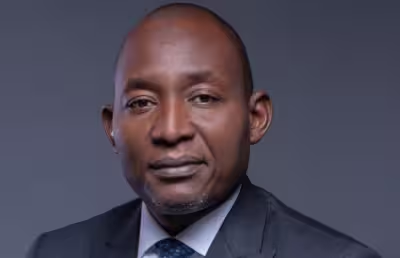





On Tuesday at the Bitcoin 2026 conference in Las Vegas, Alex Michl told the audience that adding bitcoin to a financial institution’s reserves could improve performance but warned it remained too risky for official reserve portfolios. "Its volatility is much higher than other assets," Michl said, and "One day its price may be much higher or it could go to zero. Yes, zero."
Michl used blunt, concrete examples to make the point. He said he once bought a coffee with bitcoin and that purchase has since appreciated to an absurd personal cost: "The first time I used bitcoin, I bought a coffee. Today. that coffee comes to about $350, so it was the most expensive coffee of my life." He balanced that anecdote with a portfolio-minded view: "When you add an asset like this, the whole portfolio can work better. Return can go up and risk stays about the same."
The warning landed against a backdrop of central-bank experimentation. In November the Czech National Bank became the first central bank worldwide to purchase bitcoin and announced a $1 million test portfolio that includes bitcoin, a USD stablecoin, and a tokenized deposit. The CNB said the pilot was approved a month before the public announcement and that the goal was to build hands-on experience with blockchain-based assets.
That hands-on push produced mixed conclusions. A CNB study dated February 2026 found bitcoin has low long-term correlation with many traditional assets, and the central bank said blockchain-based assets could redefine how the country’s payments and financial systems operate in the future. Yet the same CNB study said the Bank Board decided not to invest its FX reserves in bitcoin at this time.
Michl stressed the tension at the heart of the CNB exercise. He described bitcoin as offering "very high returns, but honestly it looks too risky," and compared exposure to bitcoin with venture capital: "In some ways it is similar for me to venture capital but it is much more liquid." He also reminded the room of the obvious downside: "A stock can go to zero. Even a bond can fail. So for me that is why it is not wise to bet just on one asset."
The friction matters now because institutions and traders are both watching short-term price action even as policymakers test the technology. Market coverage shows near-term debates about price direction and momentum (Analysts split on Bitcoin bottom as price hovers near $78,000, Bitcoin Price Tests $77,500 Channel Resistance at $76,466) and on-chain analysis firms are parsing flows (Glassnode Sees Buyer Interest Offset Selling Pressure in Bitcoin Outlook), all while central banks move from paper studies to live pilots.
The clearest contradiction sits in the CNB’s actions: the bank ran a pilot to gain experience but, according to its February 2026 study, stopped short of putting FX reserves into bitcoin. That split — practical testing on one hand, formal restraint on the other — is the story’s tension. Michl offered the arithmetic case for inclusion and the cautionary tale of its price swings in the same breath.
Michl’s takeaway for reserve managers was plain and human: bitcoin "can provide returns that are not closely linked to other assets," yet those returns come with the sort of risk that can turn a small, everyday purchase into "the most expensive coffee of my life." For now, central banks appear to be following the CNB playbook — run pilots to learn, measure correlations and risks, and treat any broader allocation with extreme caution.