




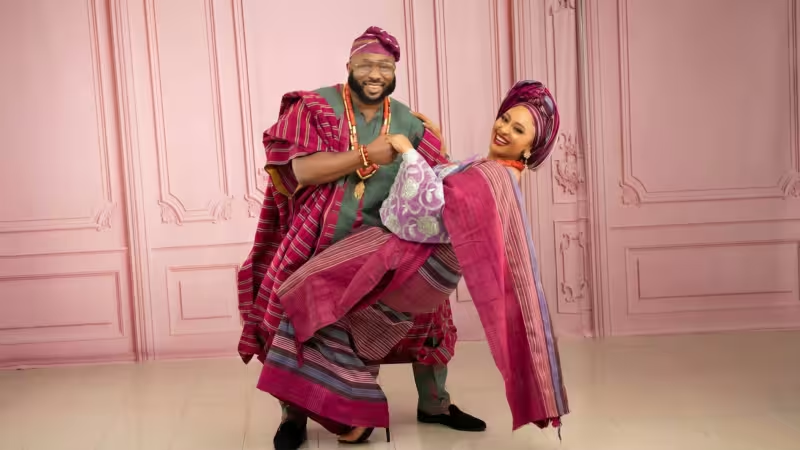
Olakunle Churchill denied reports that he divorced Rosy Meurer on Wednesday, saying the online stories are false because “there was no legally recognized marriage.”
Churchill posted a statement on Instagram rejecting the split reports and making a series of clarifying claims: “The reports circulating online about a supposed divorce between myself and Roseline Meurer are completely false. There is no truth to them, and they should be treated as such,” he wrote, adding that “there was no church wedding and no court wedding. What took place was an introduction. Therefore, the idea of a ‘divorce’ is baseless from the outset.”
The former business partner of both women also rejected any suggestion that he had been part of an official legal process. “Any legitimate legal process requires that all parties be formally served and given the opportunity to respond. I was never served,” Churchill said, and he shared an image on social media of a document that appeared to be an enrolment of judgment bearing both his name and Roseline Ufuoma Meurer’s name.
The timing matters because the rumours followed an Instagram clip in which Rosy Meurer reintroduced herself to followers and described a return to public life as a rebirth, posting without Churchill’s surname and without a visible wedding ring — a move Premium Times reported set off the speculation. Churchill’s statement arrived within 24 hours of that post and directly addressed public questions about whether a formal marriage — and therefore a divorce — existed.
Churchill also used the post to address a wider personal history that has been in the public eye. He reiterated that before his relationship with Meurer began she was aware he had a child and longstanding issues with Tonto Dikeh, and he said he rejected a narrative that Meurer had stood by him in some exaggerated way: “I do not agree with the narrative that Rosy ‘stood by me’ in a way that should now be exaggerated.”
That comment came alongside a conciliatory note about his relationship with Dikeh. Churchill said the two have put decades of dispute behind them: “If Tonto offended anyone, it should be me alone and if I offended anyone, it should be Tonto. However, we have both chosen to forgive each other,” he wrote, and added that “Tonto wronged me, and whatever existed between us was ours to resolve. No one confronted her or fought that battle on my behalf.” Recent sightings reported by showing Churchill and Tonto Dikeh spending time with their son, King Andre, have fuelled public attention on that ten-year rift and its apparent thaw.
The story contains a built-in tension. Churchill insists there is no legally recognised marriage and calls the divorce stories “false and misleading,” yet he posted a document that appears to show both his name and Roseline Ufuoma Meurer’s name on an enrolment of judgment. That image raises questions about how a public record of that kind came to exist alongside his assertion that no court wedding, and no legal marriage, took place — a discrepancy he sought to resolve by stressing he was never formally served with court papers.
For readers trying to parse what this means now: under Churchill’s account there is no legal marriage to dissolve. He has framed the relationship with Meurer as an introduction ceremony, not a church or court marriage, and he has labelled the idea of a divorce “baseless from the outset.” Whether the document he posted will prompt further legal scrutiny or explanation is the immediate next point to watch, but Churchill’s public position answers the central question raised by the rumours — he says there was no marriage and therefore no divorce to report.