



The United Arab Emirates announced on April 28 that it will leave OPEC and OPEC+ effective May 1, a decision Saul Kavonic called "the beginning of the end" for the group.
The UAE, a member of OPEC since 1967 — nearly 60 years — said in a press release that the move reflects its long-term strategic and economic vision and an evolving energy profile after recent investments to boost production capacity. The country pledged to bring additional production to the market "in a gradual and measured manner, aligned with demand and market conditions," and its energy minister said that being a country with no obligation under the group would give it more flexibility.
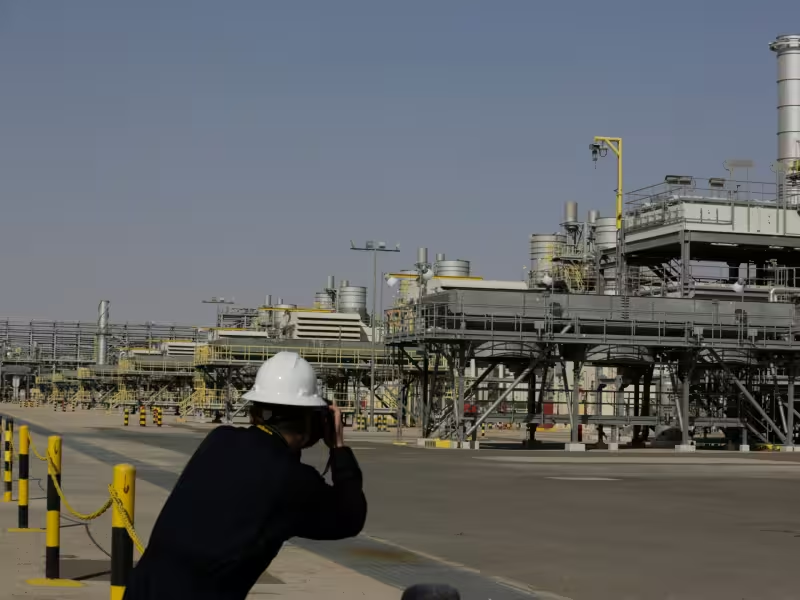
The numbers underline the magnitude of the shift. OPEC, formed in 1960 by Iran, Iraq, Kuwait, Saudi Arabia and Venezuela, currently counts 12 members; the UAE’s exit will leave it with 11. OPEC members together control about 30 percent of global supply, while the broader OPEC+ arrangement — which adds 10 non-OPEC members including Russia — accounts for roughly 41 percent of global production. The UAE itself has capacity of approximately 4.8 million barrels per day and has sought to lift its production limit to roughly 5 million barrels per day.
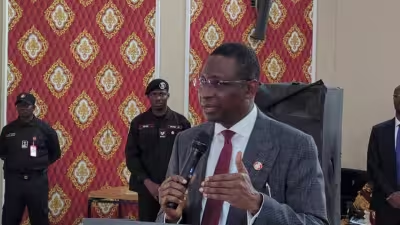
Analysts and market observers immediately tied the announcement to wider market stress. Saul Kavonic warned that with the UAE leaving, OPEC loses about 15% of its capacity and one of its most compliant members, a shift he encapsulated as "the beginning of the end." Neil Atkinson described the departure as "a major blow to the future effectiveness" of the group and said its leverage "will be clearly weakened" once normal oil production resumes after the war. Atkinson also warned that OPEC members "will attempt to sell as much oil as they can to as many people as possible."


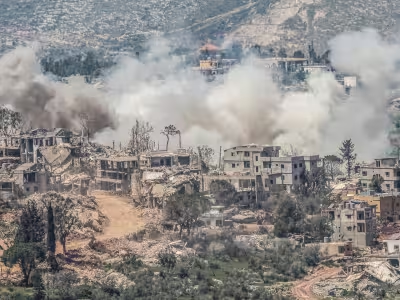
The announcement comes against the backdrop of the US-Israel war on Iran, which has been described in reports as an energy shock. Markets have already felt the strain: oil prices rose to $113 a barrel on Tuesday, compared with around $73 before the war began. Governments and agencies have intervened — the IEA oversaw the release of 400 million barrels of oil last month in an effort to blunt the economic impact of the conflict.
Those market moves help explain the UAE’s stated calculus. The government said its departure follows recent investments to boost production capacity and aims to support growing global energy demand in the long term. At the same time, the UAE has pressed within OPEC for a higher production limit and has had tensions with Saudi Arabia over oil policy and regional conflicts, a background detail that framed the exit as both strategic and political. The UAE also emphasized it would add barrels gradually, tied to demand and market conditions, rather than flooding the market.
The departure has prompted political commentary as well. Former President Donald Trump weighed in, saying OPEC was "ripping off the rest of the world" and urging steps to "bring down the cost of oil." That political pressure layers onto the economic argument the UAE made in its press release and the technical calculation of spare capacity that the country holds.
Tension in the aftermath centers on what OPEC can still do. The cartel’s ability to coordinate output and influence prices depended in part on members able and willing to follow limits; losing one of the handful with meaningful spare capacity changes the arithmetic. If the UAE follows through on gradually increasing its output toward the roughly 5 million barrels per day it has sought, global supply could loosen, but the timing will matter — and so will the behavior of the remaining OPEC members and the 10 OPEC+ partners.
The most consequential near-term fact is simple: on May 1 the UAE will no longer be bound by OPEC or OPEC+ agreements, and its spare capacity is now an independent lever in world markets. That will materially weaken OPEC’s price-setting power and accelerate a reshuffle of influence inside the producer grouping, a development market watchers say will shape oil prices and geopolitics for months to come.