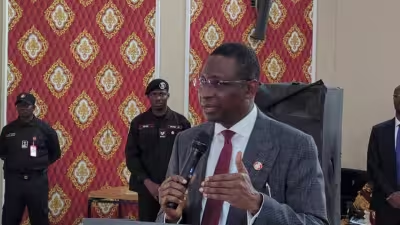




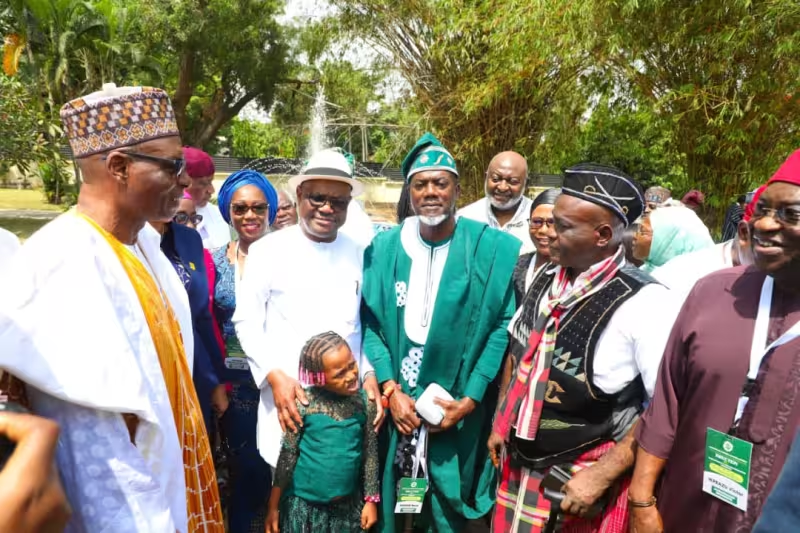
Thirty-three Nigerian ambassadors have secured agréments from host countries and are taking part in a three-day induction in Abuja, Kimiebi Ebienfa said Wednesday, as the Foreign Ministry prepares to send envoys to fill long-vacant missions.
"Thirty-three ambassadors have now secured agréments from host countries," Ebienfa said, confirming progress in a list of 65 names President Bola Tinubu put forward. The ministry added that 32 ambassadorial nominees are still awaiting approval from their prospective hosts.
The induction programme for the newly appointed envoys began on Monday and is scheduled to end on Wednesday. "After the induction, those who have been accepted will proceed to their Missions," Ebienfa said, setting out the next step for the envoys who have received host-country consent.
The numbers mark a clear acceleration: the Ministry of Foreign Affairs had reported on April 17 that "over 25 ambassadors had secured agrément," and ministry officials say the new cohort will be posted once the induction concludes and paperwork is finalised.
President Tinubu, who sent most of the names to the senate in late 2025, has framed the appointments as part of a diplomatic push. "The international system is evolving rapidly. We must be prepared to meet these challenges by focusing on how best to protect and promote Nigeria’s national interest," he told the envoys, adding that "You have a special responsibility in helping to reposition Nigeria in global affairs. The world is watching."
The timeline behind the appointments underlines the scale of the reshuffle. Tinubu sent 32 ambassadorial nominees to the senate for confirmation on November 29, 2025; the senate confirmed 64 nominees on December 18, 2025, a group described at the time as 34 career ambassadors and 30 non-career envoys. Altogether, 65 names have been published by the presidency for postings.
The ministry says several key diplomatic posts have been left vacant for some time and that many missions have been run by chargés d’affaires. That backlog is the immediate reason for the induction and the urgency from the presidency: Tinubu has urged new envoys to "aggressively pursue foreign investments, strengthen strategic partnerships and reposition Nigeria in global affairs."
Tension remains between the ministry’s recent tally and the administrative record. The presidency published 65 names, the senate confirmed 64 on December 18, and the ministry now says 33 envoys have secured agrément — with 32 still waiting — a numerical mismatch that has not been explained publicly. The listings were also touched by tragedy: Mohammed Mahmud Lele, Nigeria’s appointed career diplomat to Algeria, died on April 23, a development that will require an immediate replacement for that posting.
Adding to the practical preparations in Abuja, Minister Nyesom Wike told the envoys the president had approved land allocations in the capital so ambassadors-designate would have a permanent foothold for periodic briefings. "The President believes that most of you do not have a place in Abuja… he will encourage you to see how you will put up where you can stay. Before you leave this morning, each and every one of you should have your form to apply for a land allocation in Abuja," Wike said.
With 33 agréments secured and the induction set to conclude, the Foreign Ministry is positioned to forward a new wave of ambassadors to their host countries. But until the remaining 32 nominees receive agréments — and Washington, Paris or other capitals return their formal consents — many missions will continue to be overseen by chargés d’affaires, and Nigeria’s diplomatic offensive will remain only partly in place.