



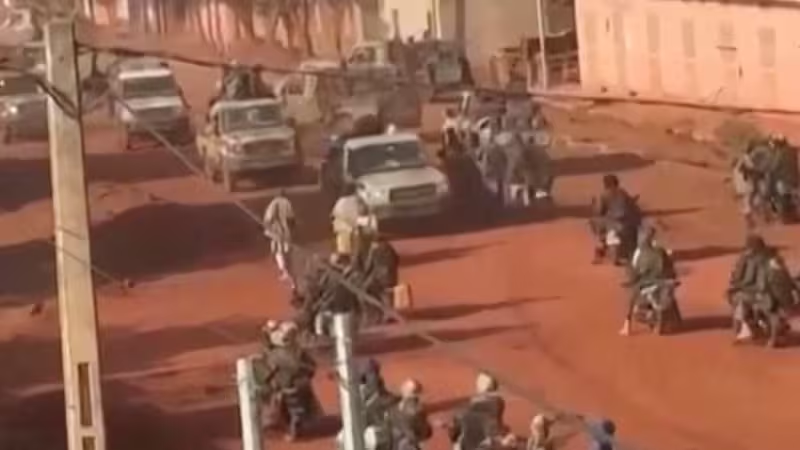
Gen Assimi Goïta faces a new test of control as Islamist militants imposed a partial blockade on Mali's capital, Bamako, just days after Defence Minister Sadio Camara was killed in an apparent suicide truck bombing on his residence near the city.
At least three of the six main routes into Bamako are now being closed for hours at a time before fighters move elsewhere, and the nearby town of Ségou — less than 80 kilometres (50 miles) from the capital — has been placed under a total blockade. Hundreds of vehicles, trucks, buses and cars are stranded in Ségou, and passengers, including families and traders, have been stuck there for days, struggling to access water and food. One unnamed lorry driver said: "I've never seen something like this before. I've been doing this job for so many years." Another described the new calculation on the road: "I'm stuck here and it sounds dangerous. I would rather run away to save my life than fight for the goods I have to deliver. I've never thought like this before."
The threat to movement has been explicit. Jama'at Nusrat al-Islam wal-Muslimin warned on Wednesday that "no-one will be allowed in any more," a message that amounted to a blunt chokehold on the capital's supply lines. The killing of Camara on Saturday and his burial on Thursday amid tight security in front of thousands of people have sharpened fears that the violence is spilling into the south and closer to the seat of power.
The attacks that preceded this week’s blockade were not isolated. Last weekend saw nationwide coordinated attacks carried out by an alliance of jihadists and separatist rebels — named in reporting as the Azawad Liberation Front and JNIM — striking across northern Mali. The pattern has left more than three million people in and around the affected areas under threat from disruption to movement and markets.
Context matters: this flare-up follows a string of confrontations that have reshaped Mali since Gen Assimi Goïta seized power in a coup in 2020. Mali's army has been working with the Russian paramilitary group Africa Corps against the insurgents, and those forces have been a central part of the government's security posture. But Russia's Africa Corps withdrew from the northern city of Kidal, the FLA now controls Kidal, and the Kremlin nonetheless said Russian forces would remain "to combat extremism, terrorism and other harmful phenomena and will continue to provide assistance to the current government." Last year Islamist groups had imposed a fuel blockade on Bamako, a reminder that supply chokes have become a recurring tactic.
The friction is stark. Goïta has claimed that armed and security forces had managed to inflict heavy losses on the rebels, but the militants have continued to coordinate strikes nationwide and to close key routes into the capital. The Africa Corps withdrawal from Kidal and the FLA's control of that city cut against the Kremlin's public line that Russian forces will remain; at the same time, the continuing blockades and the killing of a defence minister expose gaps in the government's ability to protect the south.
For the people caught on the road in Ségou the abstractions are immediate shortages and fear. An unnamed mother-of-two said plainly: "Our army isn't capable of protecting us, how are we going to get back home?" That question points to where the crisis will accelerate or ease: reopening the main arteries into Bamako and restoring safe movement for civilians and traders.
The single, urgent question now is whether Goïta's government can break the blockades and reassert control without further military assistance that is visibly present on the ground. If it cannot, the partial blockade of Bamako and the total hold on Ségou risk becoming a broader test of the state's reach — a test that will be watched across the region, including in Nigeria Newspapers and other regional outlets, as governments and civilians calculate the next move.