



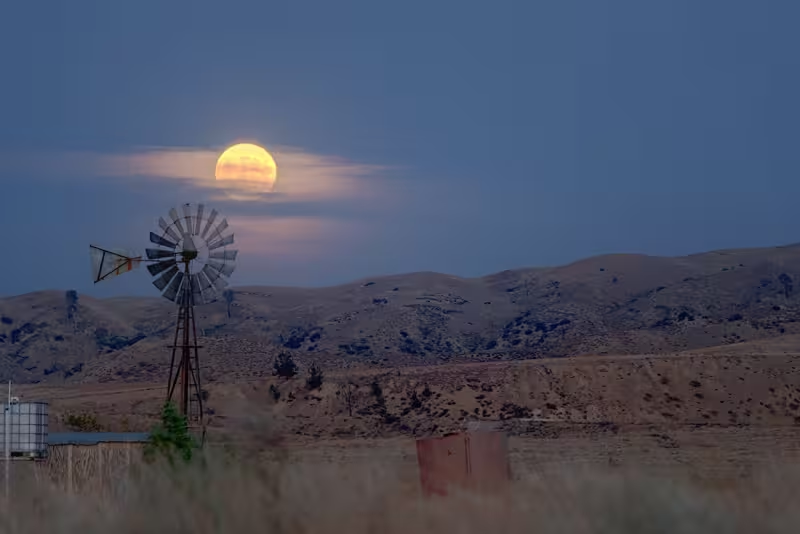
The Flower Moon rose on May 1, 2026, and whether it counted as a micromoon became the question surrounding the full moon that was photographed around the world. Some trackers said the answer was yes. Others pointed to later full moons in May and June instead.
EarthSky said Fred Espenak’s AstroPixels website counted the Flower Moon as a micromoon, while Timeanddate.com identified the next micromoon as the Blue Moon of May 30-31, 2026. That split mattered because the Flower Moon had already moved into a crowded lunar calendar: Space said it was followed by a rare full Blue Moon on May 31, and NASA said that second full moon in a single calendar month was a Blue Moon.

The debate turns on distance. EarthSky said a micromoon is a full or new moon that occurs when the moon is roughly at its farthest from Earth in its orbit, but there is no strict definition of how close to apogee it must be to earn the name. EarthSky also said the full moon at the end of May 2026 was 252,360 miles, or 406,135 kilometers, away, compared with the moon’s average distance of 238,900 miles, or 384,472 km. By that standard, the full Flower Moon was not the only candidate for a far-flung lunar label in the month.
That is why the naming depends on who is doing the counting. EarthSky said both AstroPixels and Timeanddate.com agreed the full Strawberry Moon of June 29, 2026, was a micromoon, and it said the year would include one new micromoon on December 9, when the moon would be 251,460 miles, or 404,687 kilometers, away. It also said a full micromoon appears about 12-14% smaller than a full supermoon and about 7% smaller than a full moon at an average distance.
The Flower Moon itself was named for the colorful blooms that appear in the northern hemisphere around the time it rises, and Space said it rose below the stars of Virgo. Space said the moon had come and gone, but the disagreement over its status shows how thin the line can be between a micromoon, an ordinary full moon and a calendar-driven label like Blue Moon. On that reading, the answer is settled only in part: the Flower Moon was real, widely seen and widely photographed on May 1, but the micromoon label belonged to the observer, not the moon.