




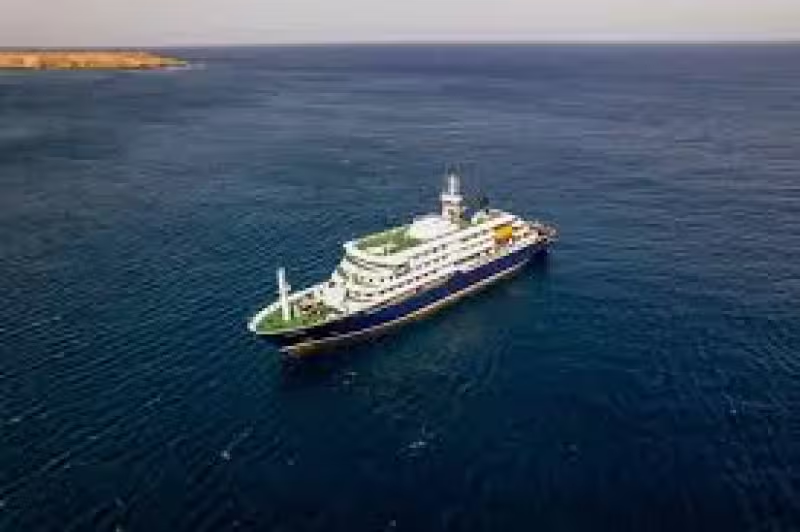
A suspected hantavirus outbreak aboard the cruise ship MV Hondius killed three people and sickened at least three others while the vessel was travelling between Argentina and Cape Verde, public health agencies said Sunday.
Sonja Bartolome warned how the illness can start: "Early in the illness, you really may not be able to tell the difference between hantavirus and having the flu." The World Health Organization said it was aware of the event and is supporting the response: "WHO is aware of and supporting a public health event involving a cruise vessel sailing in the Atlantic Ocean."
The toll reported Sunday was three dead and at least three more ill. Two of the people who died were a husband and wife from the Netherlands, aged 70 and 69. The South African health ministry said the man fell ill onboard the ship and died on Saint Helena, while the woman died at a hospital in Kempton Park, South Africa. A 69-year-old British man who became ill on the ship was taken to a private health facility in Johannesburg and, the health ministry said, tested positive for hantavirus.
The WHO said at least one case of hantavirus had been confirmed and that "Detailed investigations are ongoing, including further laboratory testing, and epidemiological investigations." The agency added that "Medical care and support are being provided to passengers and crew," that "Sequencing of the virus is also ongoing," and that it was "working with authorities to evacuate two symptomatic people from the ship." One patient was reported to be in intensive care in a South African hospital.
Operator Oceanwide Expeditions said two crew members onboard required urgent medical care and that the third fatality remained onboard the vessel as authorities handled the situation. Cape Verdean authorities had not given authorisation for the ship to disembark people requiring medical care, and Dutch authorities agreed to lead a joint effort to organise the repatriation of the two symptomatic passengers to the Netherlands and the return of the body of the deceased individual. Earlier reporting on the incident is available on Round Time News:
Hantaviruses are mainly spread by contact with rodents or their urine, saliva or droppings, though the WHO has cautioned that hantaviruses may spread between people, while rare. The U.S. Centers for Disease Control and Prevention began tracking the virus after a 1993 outbreak in the Four Corners region. Hantavirus pulmonary syndrome, the syndrome most familiar to North American clinicians, usually appears one to eight weeks after contact with an infected rodent and can be severe: the CDC estimates it can be fatal in nearly 40% of infected people. The other hantavirus syndrome, hemorrhagic fever with renal syndrome, typically develops within one to two weeks after exposure and has a lower death rate of 1% to 15%.
The disease has long been on the public-health radar outside this episode: hantaviruses have been documented in Asia and Europe for centuries, and attention in the United States returned after high-profile cases in the 1990s. "New Mexico and Arizona are hotspots," Michelle Harkins has noted in describing U.S. patterns, and the disease gained public attention after Betsy Arakawa died from a hantavirus infection in New Mexico.
The immediate friction in the response is logistical as well as scientific. The ship lacked permission to disembark sick passengers in Cape Verde, yet authorities and the WHO are trying to move two symptomatic people off the vessel and repatriate them. Oceanwide Expeditions says a fatality remains onboard even as two crew members need urgent care, and sequencing and further laboratory tests have not yet returned results that would clarify whether this cluster represents rodent-borne spillover only or includes any rare human-to-human spread.
The central question now is whether the sequencing and epidemiological work will show evidence of human-to-human transmission aboard the MV Hondius. If tests confirm a single rodent-linked strain, the public health response will focus on containment and repatriation; if evidence points to onward spread between people, international health agencies and the countries involved will need to expand contact tracing and clinical isolation measures rapidly. Until those laboratory results arrive, the deaths and the confirmed case stand as a stark reminder of how quickly hantavirus can become deadly and why officials are treating the ship as a public-health emergency.