

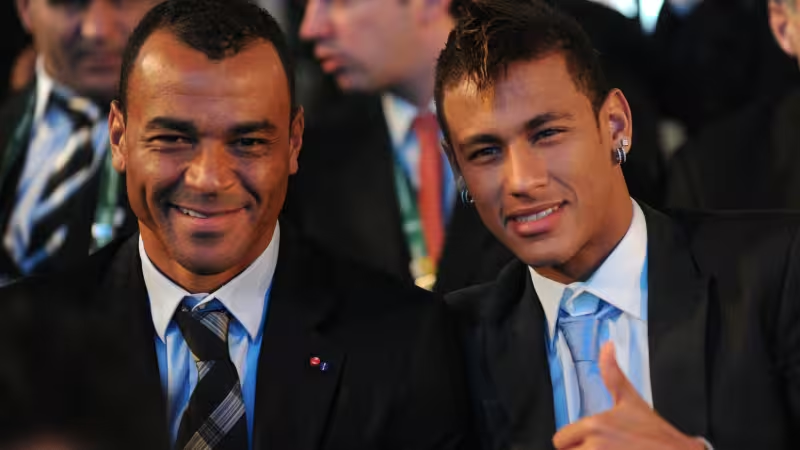
Cafu said Neymar was technically superior to Cristiano Ronaldo and Lionel Messi and publicly backed the 34-year-old to lead Brazil at the 2026 World Cup — but added that only coach Carlo Ancelotti can decide if the forward is ready.
“For me, Neymar was technically even better than [Cristiano] Ronaldo and [Lionel] Messi,” Cafu said, adding: “He’s had a brilliant career.” The former Brazil captain said any team with a decisive player like Neymar needs that player, and that if Neymar is “physically fit, tactically fit, technically fit” he is the kind of player who can decide games. “But only Ancelotti can decide and only Neymar can know if he’s ready,” Cafu said.
The endorsement from Brazil’s most capped World Cup veteran carries weight. Cafu remains the only man to play in three consecutive World Cup finals and he spoke from a place of experience as Brazil searches for a first global crown since 2002. Neymar, now 34 years old, has been hindered by numerous injuries in recent seasons and is struggling to rediscover his best form at Santos, a reality Cafu acknowledged even as he backed the forward.
Carlo Ancelotti, the first foreigner to take sole charge of Brazil’s national team, has set out to blend an Italian defence with a Brazilian attack — a strategy Cafu said can work. “Ancelotti is the most Brazilian Italian coach there has ever been because he has worked with so many Brazilian players,” Cafu said. “The Brazilian essence will always be there,” he added, and when asked whether he was comfortable with Neymar leading the side, Cafu said simply: “I’m comfortable with it.”


Cafu’s backing arrives as Brazil’s new leadership prepares selections and tactics for the 2026 FIFA World Cup. The former right-back put the choice squarely in Ancelotti’s hands while underlining the narrow path Neymar must walk: reputation and talent are not enough when injuries have left match readiness in doubt.
The gap between Cafu’s high praise and Neymar’s current form is the story’s tension. Cafu celebrated Neymar’s technical gifts and historic contributions, but acknowledged the blunt fact that recent seasons have been ridden with setbacks. That leaves the national team with a choice defined by fitness and immediate performance rather than legacy. Cafu’s take reduces the decision to a binary test: is Neymar match-fit and tactically prepared for the demands of a World Cup run?
Cafu also reached back to Brazil’s last triumph to underline his point about team spirit and unexpected routines: he recalled playing golf in a hotel corridor the night before the 2002 final against Germany because Ronaldinho “had a ball and a club in his room.” “We played golf,” Cafu said, remembering that he, Ronaldo, Roberto Carlos, Lúcio, Roque Júnior and Edmilson spent perhaps an hour and a half in the corridor. The anecdote was offered as a reminder that teams win on more than paperwork and projection.
If Neymar can return to the levels Cafu remembers, the veteran argues he should be central to Brazil’s plan; if he cannot, Ancelotti will be forced to find another route. The decisive moment for Brazil is therefore not a vote of confidence in a name — it is the clearer, narrower test that Cafu set out: fitness, tactics and technique, judged by Ancelotti, with the 2026 World Cup looming as the final arbiter.