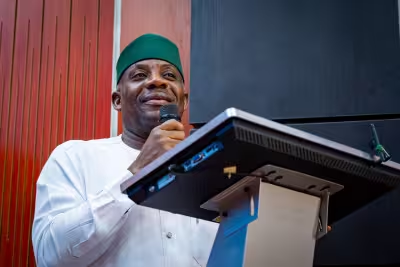




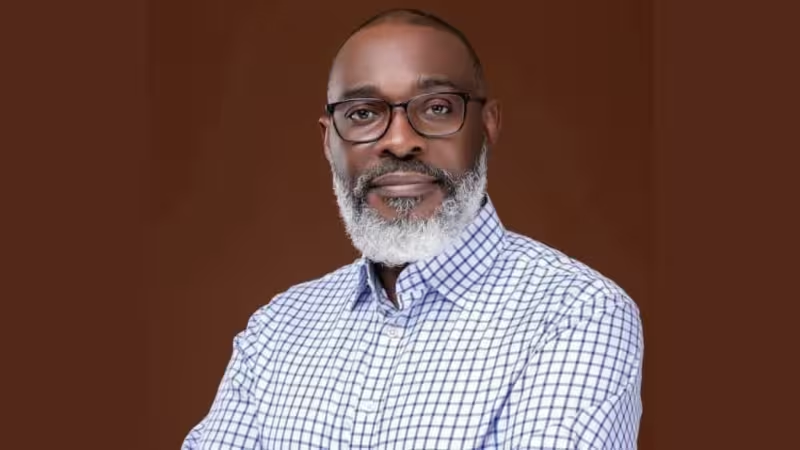
President Bola Tinubu on Monday appointed Adeyinka Famadewa as his Special Adviser on Homeland Security, a move announced by the Office of the Secretary to the Government of the Federation. The office described Famadewa as a highly decorated retired general with over three decades of military and intelligence service.
The SGF’s office said Famadewa will help strengthen the administration’s push for a safer Nigeria by improving coordination of homeland security initiatives, intelligence integration and proactive risk management. It said his career spans national security strategy, intelligence fusion, counter-terrorism operations and international security diplomacy, and that his record reflects operational excellence, strategic foresight and institutional leadership.
Famadewa’s background fits the role on paper. He was commissioned into the Nigerian Army Intelligence Corps in September 1990 as a member of the 37 regular course of the Nigerian Defence Academy in Kaduna. He has a bachelor’s degree in chemistry from the NDA and two masters degrees, one from the Federal University of Technology, Akure, and another in strategic studies from the University of Ibadan. He also completed the junior and senior command and staff courses at the Armed Forces Command and Staff College in Jaji and attended security programmes at Harvard University’s Kennedy School of Government, the Canadian Forces College in Toronto and the George Marshall Center in Germany. He is also a fellow of the National Defence College.


His service record includes posts as chief instructor at Nigerian Army Intelligence School in Lagos, deputy director of technical development at DIA, commander of counter-intelligence command in the Nigerian Army and director of the intelligence production centre. He also served on a United Nations Mission in Sudan as Sector J2 and holds military decorations including the meritorious service star.
The appointment has already drawn attention because Famadewa had publicly weighed in on Nigeria’s security problems before taking office. In a 2023 PREMIUM TIMES article, he compared the country’s national security conversation to Salt-N-Pepa’s song “Let’s talk about sex,” arguing that the debate had gone on for 15 years with too much being said and too little done. He wrote that the national security conversation in Nigeria for the last 15 years is akin to Salt-N-Pepa’s song on the subject, and added: “To support this belief, the writer stated in the lyrics that the song would be prohibited by the radio services. However, surprisingly or even disappointingly enough, the song was all over the radios at that time because so much was said and yet, so little was said.”
That earlier critique now sits beside his new assignment, and it is the source of the tension around the appointment. TheCable described the selection as a surprise and said it has been widely viewed as another decorative addition to a security system critics say has produced more structural adjustments than measurable gains in safety. Nigeria News also reported significant public debate over the move, noting that Nigeria already has a domestic security architecture that includes the Ministry of Interior, the DSS, the ONSA and the NCTC. It said the Ministry of Interior oversees immigration, correctional services, civil defence and fire services; the DSS handles internal intelligence and domestic security; the Office of the National Security Adviser coordinates national security strategy and inter-agency collaboration; and the National Counter Terrorism Centre already exists as a specialised multi-agency platform for terrorism and emerging threats.
For Tinubu, the question is no longer whether Famadewa is qualified. It is whether another homeland security office can produce more than another layer in a system that has long promised coordination and still has to prove it can deliver safety.