




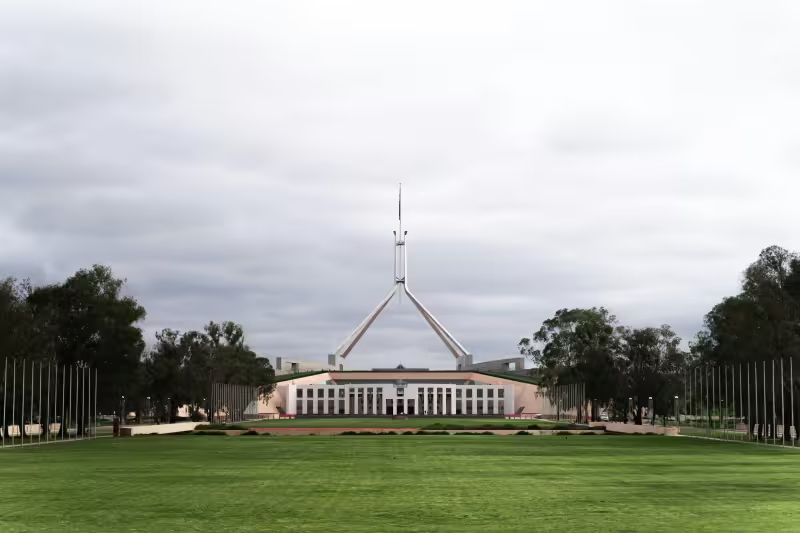
The inaugural LGBTQ+ Economists and Allies in Asia-Pacific Summit took place at the University of Melbourne as a speaker welcomed attendees and pointed to a major change coming in Australia’s next census. The upcoming August Census will, for the first time, include questions on sex, gender identity and sexual orientation.
“Hello everyone - and thank you for the invitation to speak at the inaugural LGBTQ+ Economists and Allies in Asia-Pacific Summit,” the speaker said, before adding that the census change matters because “good policy begins with good measurement.”
The timing is significant because the speech landed in 2025, ahead of a census that will gather information Australia has never asked for in this way. The speaker said the new questions will give policymakers a clearer picture of LGBTIQA+ people’s lives, and tied that directly to economic outcomes, health planning and service design.
The argument was backed with numbers. The speaker said the 2021 Census showed 1.9 per cent of couples in the Australian Capital Territory were same-sex couples, compared with the national average of 1.4 per cent. Canberra, the speaker said, has the highest share of same-sex couples of any state or territory in Australia.
That matters because the data gap has long shaped how governments see the community they are trying to serve. Australia’s National Action Plan for the Health and Wellbeing of LGBTIQA+ People says it is aiming for equitable health and wellbeing outcomes through safe, respectful, high-quality and inclusive services, and it names evidence-based continuous improvement as a core principle. The census change is the kind of measure that can make that principle real instead of rhetorical.
The speech also pointed to labour-market evidence that has helped frame those policy debates. It cited a study by Kristen Schilt and Matthew Wiswall that found transgender women experienced a substantial decline in earnings after transition while transgender men saw modest increases. That contrast underscored the wider point: when governments lack reliable data, they struggle to see where inequality is concentrated and how it changes over time.
The friction in the story is plain. Australia is about to collect more detailed information on sex, gender identity and sexual orientation, but the people designing policy will still have to decide how to turn that information into services that actually reach LGBTIQA+ people. The census can improve the map. It cannot, by itself, fix the road.
What the summit made clear is that the next census is not just a statistical exercise. For the first time, it will give Australia a fuller basis for measuring who is being counted, who is being missed and whether policy is matching the lives it is meant to serve.