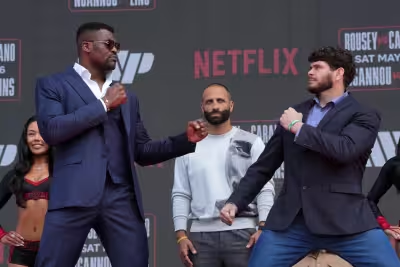




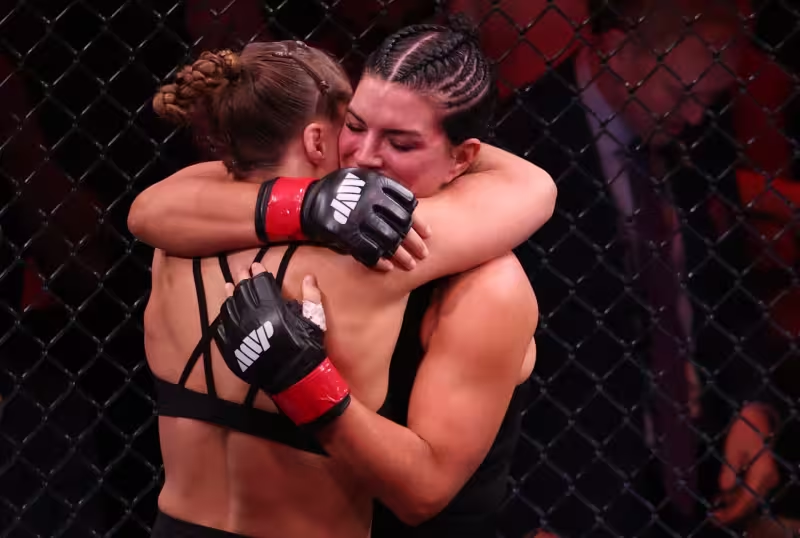
Ronda Rousey submitted Gina Carano with a trademark armbar inside seconds of the opening bell at the Intuit Dome in Los Angeles on Saturday.
The finish — described in some accounts as coming in 15 seconds and in others as 17 seconds — was Rousey’s 13th win in 15 professional fights and her 10th victory by armbar submission. Rousey, 39, ended a comeback bout promoted by Most Valuable Promotions that was the first MMA show to be broadcast on Netflix.
Carano, 44, had not fought in mixed martial arts since August 2009 and spent more than two years shedding over 100 pounds to return for the match. She said afterward, "Right now, just getting in the cage was a victory, getting here after 17 years is a victory," and called fighting Rousey "a victory in my life."
Rousey returned to the cage after exiting MMA in December 2016 following losses to Holly Holm and Amanda Nunes and a high-profile retirement from the UFC that year. Her earlier run at bantamweight included a then-record six title defences; she had become the first woman signed to the UFC in 2012 and helped reshape the sport’s profile for female fighters.
After the bout Rousey paid repeated tribute to Carano’s role in her own rise, saying, "Gina is a person who brought me into MMA, she is the only person who could bring me back into MMA. She's my hero," and adding that Carano had "brought me back home when no-one else could, and she showed me where my home was. You changed my world, and we changed the world. I could never be able to pay you back enough." Rousey also said, "There’s no way I could have ended it better than this. I want to have some more babies, got to get cooking," and she ruled out continuing to fight, calling the event her last.
Carano answered the applause with a mix of pride and frustration. "I feel great," she said, but added, "I wanted to fight, and I didn’t get that," and "I wanted that to last longer – I felt like I was so ready, I felt so good." She framed the night as a personal victory regardless of the result: "Fighting a legend was a victory."
The bout carried clear symbolism: two fighters widely regarded as among the most important women in MMA met on a platform that was both a commercial experiment and a personal finale. The show, put on by Most Valuable Promotions and streamed by Netflix, marked a novel distribution for mixed martial arts and gave the rematch a global audience even as it unfolded in Los Angeles.
The speed of the finish also left an unavoidable detail unresolved. Records and reports circulating after the fight list two different stoppage times — 15 seconds in some accounts, 17 seconds in others — a small but sharp discrepancy that underlines how swiftly the narrative of a fight can be written and rewritten. That gap does not change the outcome: Rousey used her signature armbar to force Carano to submit, extending Rousey’s armbar totals and closing a chapter on a career that twice helped define women’s MMA.
What happens next is straightforward by Rousey’s own words: she declared this the end of her fighting career and spoke of family plans rather than more comebacks. If she keeps that promise, Saturday will stand as the final public chapter in a career that began with an Olympic judo medal and rose to the mainstream through a string of title defences and defining moments for female athletes in the cage.