



Google rolled out a new Search experience this week that foregrounds AI summaries and pushes traditional search links farther down the page, and a single-word query has exposed a strange failure: searching for the word “disregard” can cause the AI Overview to reply, “Understood. Message disregarded.”
The response does more than answer oddly. Reporters found the AI Overview can leave a large block of white space that obscures results below it, forcing users to scroll past the summary to reach conventional links. The Merriam-Webster link still appears in results if users scroll down far enough, but the first thing many will see now is the AI Overview rather than the familiar dictionary box or Featured Snippet.
Two tech sites reported the problem this week. 9to5Google said searching for “disregard” leaves the AI Overview saying it will “disregard the previous prompt,” and that the same behavior happens with other command-like words such as “ignore” and “dismiss.” MacRumors reported that words with similar meanings like “ignore” and “stop” produce the same result, and that other command-like statements such as “remember” also trigger the broken AI Overview replies.
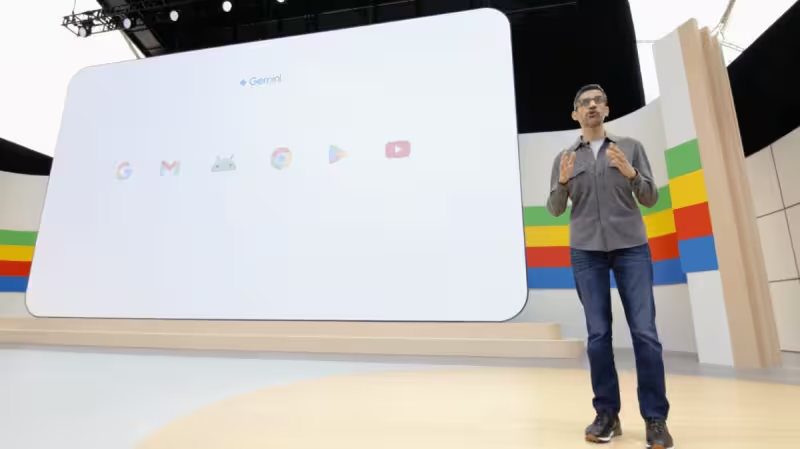
Both outlets tested simple workarounds and found inconsistent results. 9to5Google said adding the word “definition” to searches for these words does not always work. MacRumors noted the behavior coincided with Google’s introduction of an AI-forward version of Google Search at its I/O developer event on Tuesday, describing the new tool as an “intelligent search box” powered by the newest version of Gemini.
The change this week replaces the old first-screen experience for single-word lookups. Before AI Overviews, Google Search could show a dictionary box or a Featured Snippet from sites such as Merriam-Webster immediately for individual words. Now, an AI summary intended to synthesize results appears first and can, in some cases, behave as if the search itself were an instruction to the model rather than a request for a definition.



The practical effect is a visible shift: traditional results that used to sit at the top of the page — the compact, familiar set of links often called the “10 blue links” — now sit below an AI-generated block. For straightforward queries where users expect a quick definition, that change has begun producing confusing and unhelpful outputs.
Google has not provided further detail on the issue. The sources say the problem is likely to be patched going forward, but the behavior has already appeared across a set of simple, command-like words this week, suggesting the fault is systemic rather than isolated to one entry.
The contradiction is clear: AI Overviews are meant to summarize results and surface answers faster. Instead, with certain single words the Overview appears to treat the query as an instruction and either acknowledges a non sequitur — “Understood. Message disregarded.” — or hides the familiar link structures beneath a large, empty white area. That gap between design intent and what users see is the friction that makes the change newsworthy.
For now the Merriam-Webster result remains accessible if users scroll, and journalists have documented the same pattern across several query terms. But the shift this week shows how replacing a short, reliable feature with an AI layer can break basic expectations: when a search engine’s summary behaves like a command interpreter, the first-screen answer may be wrong or unhelpful, even when authoritative sources remain on the page below.
The most consequential fact is straightforward: Google introduced the AI-forward Search this week, the behavior has been reproduced across multiple words, and the company has not yet explained the cause. The sources say a patch is likely, which means the problem will probably be fixed — but not before many everyday searches for words like “disregard,” “ignore” and “stop” have already returned baffling replies instead of the simple definitions users expected.