




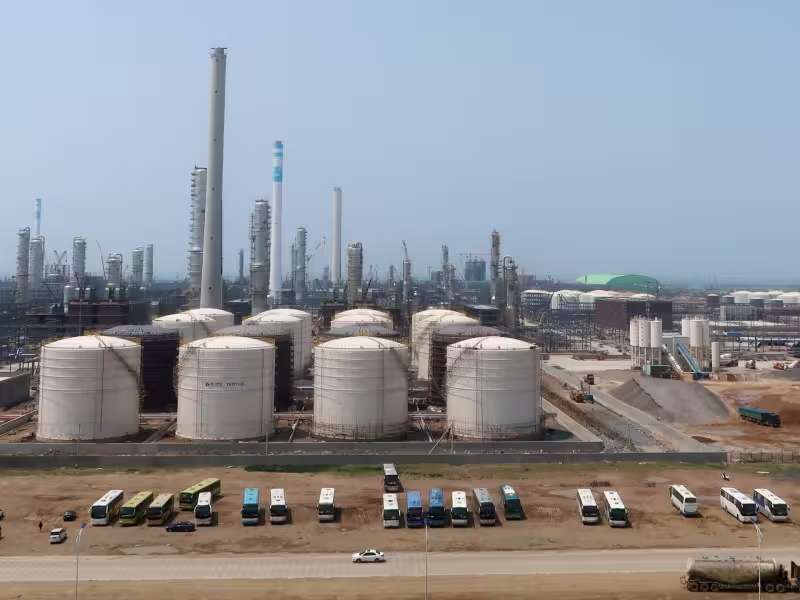
China's Ministry of Commerce on Saturday issued a prohibition order blocking U.S. sanctions aimed at five Chinese refiners accused of buying Iranian crude, including Hengli Petrochemical (Dalian) Refinery, saying Washington's measures should not be accepted by Chinese companies.
Scott Bessent, the U.S. official leading an intensified Treasury campaign against Iran, has argued Washington's pressure is choking Tehran's revenue streams; the U.S. Treasury last month named Hengli in sanctions announced on April 24 and described the company as a top customer of Tehran that had generated hundreds of millions of dollars for Iran's military through crude purchases.
The prohibition order from Beijing says the U.S. sanctions improperly interfere with commerce between Chinese firms and third countries, violate international law and the basic norms of international relations, and therefore must not be recognized or complied with by Chinese entities. The ministry framed the move as necessary to protect national sovereignty, security and development interests and reiterated that China opposes unilateral sanctions that lack United Nations authorization.
The timing and scale underline why the dispute matters now: five refiners are caught in overlapping campaigns. Hengli was singled out by the Treasury on April 24, while the other four firms named by Beijing were targeted under U.S. measures imposed last year. Beijing's order directly challenges Washington's attempt to extend the reach of its financial penalties to foreign companies that trade with Iran.
China relies on the Middle East for more than half of its oil, and independent data provider Kpler says China bought more than 80 percent of the oil Iran shipped in 2025. That flow has made smaller, independent processors — the so‑called teapot refineries — an important node in China's supply chain. These refineries operate apart from state giants, account for roughly a quarter of Chinese refinery capacity and often run on thin or negative margins.

Those narrow margins and soft domestic demand have left the teapot operators vulnerable. U.S. sanctions have added practical obstacles: refiners face trouble marketing and shipping refined products under correct origin markings and encounter banks and counterparties wary of secondary penalties. For many of the firms named by Washington, those complications have meant squeezed sales and tighter financing options.
The clash exposes a real contradiction. Washington says it is intensifying sanctions to choke off Iran's financial networks — a campaign described by U.S. officials as Operation Economic Fury and defended publicly by Bessent as effectively suffocating the regime's funding. Beijing counters that unilateral measures without U.N. backing amount to illegal extraterritorial coercion and are intolerable when they hit Chinese trade and industry.
That gap matters for global commerce and legal precedent. Beijing's prohibition order does not remove U.S. sanctions; it tells Chinese firms they are not obliged to assist enforcement. In practice, the ruling will complicate compliance for multinational banks and trading houses that operate under U.S. and other jurisdictions. It also hands Chinese refiners a formal shield they can cite if they decide to keep buying discounted crude tied to Tehran.
For the refiners themselves, the immediate effect is pragmatic: Beijing's move may ease the risk of domestic penalties for doing business with Iran, but it will not erase the obstacles those companies face when trying to sell products abroad or access dollar clearing and insurance. For Washington, the order raises the stakes of a campaign that depends on co‑operation from third countries and private firms.
China's prohibition is a clear escalation — a legal countermove that will blunt some U.S. pressure while heightening friction between the two powers. The most consequential question now is whether the United States will pursue broader secondary measures or recalibrate enforcement strategies, and whether Beijing will follow with further trade or legal countermeasures; until those choices are made, refiners such as Hengli will sit at the centre of a showdown over sanctions, sovereignty and the future shape of global energy commerce.