




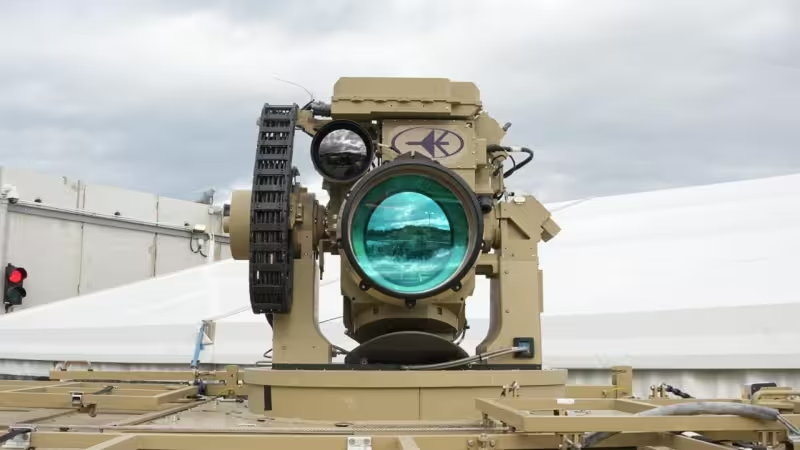
The Israel Air Force said on Friday that the Iron Beam laser defense system was used less in the war with Iran because the system requires 14 batteries to have a significant enough impact.
The admission follows an earlier acknowledgment on March 12 that the Israel Defense Forces were not using the Iron Beam regularly during Operation Roaring Lion. The March statement and Friday’s comment together underline a gap between the system’s formal entry into service and its role on the battlefield.
The record shows the laser concept has been in action in limited ways for more than a year. Various forms of Israel’s laser defenses were used in the fall of 2024 to shoot down around 40 Hezbollah drones, and Defense Ministry briefings in October 2024 also described similar shoot-downs. In June 2025 the Defense Ministry and Rafael said Lite Beam was operational. By mid-September 2025 the ministry announced Iron Beam was operational and said a full series of batteries would be deployed across the country within the upcoming months; the ministry disclosed in December 2025 that Iron Beam had been rolled out in the field.
Those milestones matter because the Israeli defense establishment has counted on lasers to change the economics and logistics of short-range air defense. The IDF and the Defense Ministry expected Iron Beam to begin reducing the cost of shooting down aerial threats in 2025. The math is simple on paper: Arrow interceptors can cost millions of shekels to fire, Iron Dome interceptors cost tens of thousands of shekels, and firing the Iron Beam has been described by officials as being as cheap as turning on a light.



The friction is obvious. The system was announced as operational and put into the field, and yet it was not used regularly during a named operation and — according to the air force — was used less in the recent war because it needs 14 batteries before it can make a large difference. That helps explain why, despite rollouts and limited successful engagements, lasers have not replaced kinetic interceptors as the day-to-day tool of short-range defense.
Strategic expectations also diverge on pace. Some sources say it could take a number of years for Iron Beam to move ahead of Iron Dome as the lead short-range air defense system. More broadly, some projections set a minimum of five to 10 years before laser systems could be counted on to defend against long-range threats such as Iran’s ballistic missiles. Those projections sit uneasily next to the public schedule of deployments and the immediate pressures of a shooting war.
Operational limits explain part of the delay. A laser’s effectiveness depends on sustained power, atmospheric conditions and coverage density — hence the reference to a 14-battery threshold. Until that network is in place, the Defense Ministry’s rollouts are partial, and commanders will continue to rely on proven interceptors for the majority of engagements.
That reliance is not just about effectiveness; it is about risk management. When the alternative is an incoming rocket or missile, commanders use tools that offer the highest chance of interception in the moment. Iron Dome interceptors, though expensive compared with a laser pulse, are a mature, widely deployed option. Iron Beam can cut per-engagement cost dramatically, but only if it can be fielded at the scale the air force now says is necessary.
Absent a rapid, large-scale deployment of the 14 batteries the air force identified, Iron Beam is likely to remain a complementary system — valuable in niche roles and demonstrably effective against drones, but not yet the backbone of short-range defense. The more consequential reality is that iron dome will continue to shoulder most interceptions in the near term, while planners figure out how quickly and reliably the lasers can be expanded to the density the air force has signaled is required.