



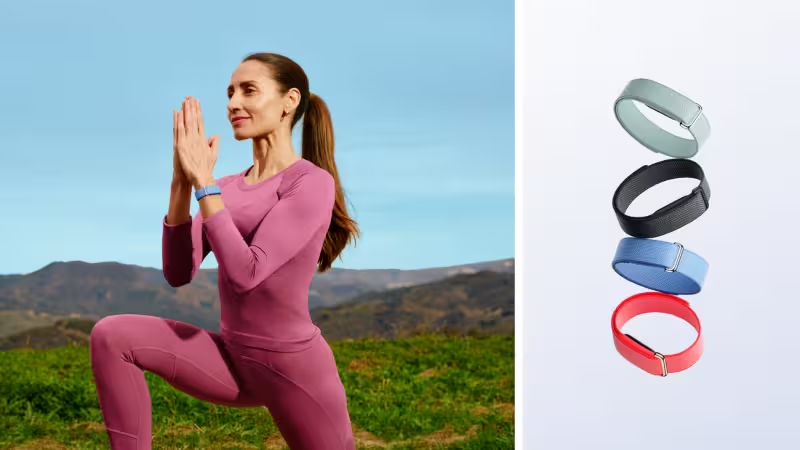
Google introduced the Fitbit Air in a blog post Thursday, calling it the company’s smallest and most affordable tracker and rolling out a new, screenless approach to continuous health monitoring. Rishi Chandra framed the device as part of a broader push to make elite-level health guidance available to everyday users.
The Fitbit Air is a tiny, pebble-shaped wearable that pairs with the Google Health app and is built for comfortable, 24/7 health monitoring without a screen. Google says the device uses high-fidelity sensor technology to deliver advanced fitness insights and sleep tracking while remaining “not bulky or distracting.” It provides up to a week of battery life, and fast charging gives the device a full day of power in five minutes.
On features, Google lists continuous metrics that are usually associated with larger wearables: 24/7 heart rate tracking, heart rhythm monitoring with Afib alerts, SpO2, resting heart rate, heart rate variability, sleep stages and sleep duration. The Fitbit Air automatically detects workouts and syncs with the Google Health app, and Google advertises advanced fitness insights alongside sleep monitoring as core selling points.
Pre-orders start at $99.99 and include a three-month trial of Google Health Premium. Google will update the existing Fitbit app to become the Google Health app on May 19, and Entrepreneur reported the Fitbit Air ships on May 26. The pre-order price, the promised week-long battery and the bundled trial figure into what Google described as an accessible entry point into continuous monitoring and coaching.
Chandra laid out the logic behind the software that pairs with the hardware. "An athlete today has a whole team doing this…They have a nutritionist, they have a sleep coach, they have a fitness trainer," he said, and added, "Why can’t all of us have that equivalent? And that’s really what the health coach is all about." The Google Health app will include Google’s AI Health Coach powered by Gemini models.


That coach is central to Google’s strategy: the company said it will convert the Fitbit app into the Google Health app on May 19 and is already baking AI features into the experience. Google also said it is working to add AI coaching support in Google Health for Apple Watch and other devices later this year, signaling an intent to extend the service beyond Google-made trackers.
The launch creates an immediate tension. Google is pitching a low‑cost, screenless device to expand the pool of continuous-monitoring users, while some industry voices argue that the absence of a screen is a defining choice. Will Ahmed put it bluntly: "If it has a screen, then it’s a watch." He added, "If it’s a watch, then you can’t wear two watches." That argument highlights a trade-off: screenless trackers can be less obtrusive and cheaper, but they may not win over users who value on-device readouts and the interactive features of smartwatches.
Market context helps explain Google’s move. Supplementary reporting shows Google wants to attract users of Apple Watch, Oura and Garmin as well as people who don’t yet use trackers; meanwhile, sales for screenless fitness trackers surged 88% between 2024 and 2025 in Entrepreneur’s reporting. Google’s bet is that combining a cheap, wearable pebble with an AI coach in a central app will pull a broader audience into continuous care.
The immediate next steps are fixed: the Fitbit app becomes the Google Health app on May 19, pre-orders are open now at $99.99 with a three-month Premium trial, and, according to reporting, the Fitbit Air ships on May 26. Google's clear wager is that lower cost and a background-first design, amplified by AI coaching from Gemini, will expand its user base more than a traditional screened smartwatch could.
In the end, Google is selling a simple proposition through both device and software: make monitoring invisible and the coaching smart enough that anyone can get guidance once reserved for elite athletes. Chandra’s question — "Why can’t all of us have that equivalent?" — is both the pitch and the test for whether the approach will change how people wear health tech.