




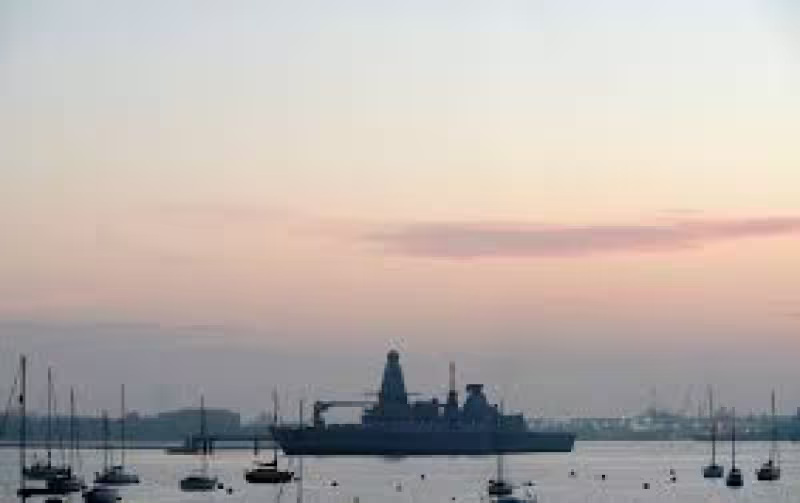
The Royal Navy announced on Saturday that it is sending HMS Dragon to the Middle East, saying the Type 45 destroyer could join an international effort to safeguard shipping in the Strait of Hormuz and will pre-position in the region ahead of a potential, strictly defensive deployment.
Sir Keir Starmer, commenting after a recent international meeting, said dozens of countries had offered to "contribute assets" to the joint operation with France and has repeatedly warned the UK will not be "dragged" into the wider conflict — remarks that frame the political context for the move.
The deployment carries measurable heft: HMS Dragon is one of Britain's six Type 45 destroyers and is described among the Royal Navy's most advanced warships. The Ministry of Defence said the mission is "strictly defensive and independent" and called the decision "part of prudent planning," adding it "provides the UK Armed Forces with additional options for the defensive multinational Hormuz mission."
Those options matter now because the Strait of Hormuz is a chokepoint for global energy flows, used to move roughly 20% of the world's oil and liquefied natural gas. Last month, 51 countries met to discuss how to protect commercial shipping there, and the new UK deployment is explicitly linked to that multinational effort.



The move follows a string of regional incidents. HMS Dragon was recently operating in the eastern Mediterranean where its primary role shifted to defending British air bases in Cyprus after RAF Akrotiri was hit by an Iranian-made drone in March. The destroyer had to be docked shortly after arriving in Cyprus after experiencing a minor technical issue, the Ministry of Defence said, and Cyprus remains, it added, "well defended."
The timing also marks a milestone: the Royal Navy ship sent to the Middle East would be the first deployed since the start of the Iran war in late February. Iran has been controlling the Strait of Hormuz for months in retaliation for US and Israeli attacks, though a ceasefire between the US and Iran has been in place since April. Both sides, however, have accused the other this week of launching attacks in the strait, underlining how quickly tensions can flare.
There is a practical seam of capability and constraint behind the announcement. Another British ship, RFA Lyme Bay, is still being kitted out with autonomous mine-hunting equipment ahead of a possible deployment, which leaves HMS Dragon as the immediate, high-end platform London can offer. The MoD framed the Dragon move as a preparatory step: the ship will pre-position ahead of what it called a "future defensive mission," preserving the option to act without binding the UK to offensive or coalition-led maritime interdiction.
The friction in the story is straightforward. London insists the role will be defensive and independent, even as the region remains volatile and Iran exerts control over the strait. Political leaders, including Starmer, have stressed restraint — he said dozens of countries had offered to "contribute assets" and has warned the UK will not be "dragged" into the conflict — but the actual deployment places British warfighting capability in a theatre where incidents are happening week to week.
Putting HMS Dragon on station therefore does two things at once: it increases the UK’s immediate options for a multinational, defensive effort in Hormuz and signals that Britain intends to deter threats to commercial shipping without joining offensive measures such as a blockade. Given the recent meeting of 51 countries and the MoD’s insistence that the mission is "strictly defensive and independent," the most likely near-term outcome is a calibrated British presence that supports allied protection of shipping while avoiding escalation.