



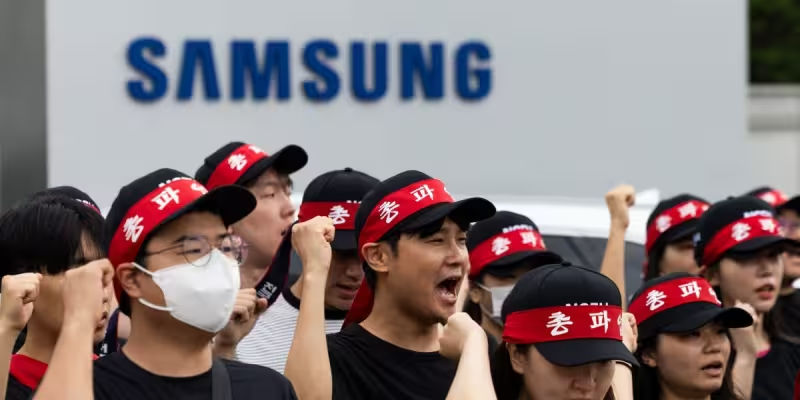
Nearly 45,000 unionized employees at Samsung are set to walk off the job starting May 21 for an 18-day strike, union leaders said, a stoppage they and company officials warn could grind key chip production to a standstill.
Choi Seung-ho, chairman of the unions representing the workers, framed the strike as a direct response to this spring’s profits and what he called a failure to share them: Samsung posted a record jump in operating profit in Q1 2026, yet workers received none of the payout. The unions are demanding that 15% of operating profit be allocated to a bonus pool, the removal of a cap that currently limits bonuses to 50% of base salary, and a 7% wage increase; management countered with a one-time payment equal to roughly 13% of operating profit for 2026 and would not agree to permanent structural changes.
The scale of the walkout matters immediately. Samsung makes about one-third of the world’s DRAM and, with SK Hynix, controls roughly two-thirds of the global DRAM market; the two companies hold an even larger share of the high-bandwidth memory (HBM) market. The firms are two of only three companies that make HBM, along with Micron. Industry officials say a prolonged stoppage at Samsung would be the largest work stoppage in the history of the semiconductor industry if it takes place as planned.
Negotiations have already shown how brittle the situation is. A 17-hour session at the National Labor Relations Commission on May 13 failed to produce a deal. The NLRC initially proposed roughly 40 trillion won in total bonus payouts. Samsung later sent a letter proposing further direct dialogue; the union said it would accept that direct dialogue only if co-CEO Jun Young-hyun personally presents concrete proposals on the key issues. Management has not committed to permanent structural changes, and the two sides remain far apart.



Tension has a recent precedent: in April, a one-day labor walkout reportedly cut foundry output by 58% and memory fabrication by 18% during the affected shift. Samsung executives have said they believe a full shutdown is possible during the planned 18-day span beginning May 21. The company operates 12 fabrication lines and employs over 260,000 people worldwide, and it is spending $73 billion on semiconductor capex and R&D this year — stakes that give both sides leverage and urgency.
Unions point to sk hynix’s settlement last September — which allocated 10% of annual operating profit directly to employees as performance bonuses for the next decade — as a benchmark. Choi told negotiators that roughly 200 Samsung employees have left for SK Hynix over the past four months, underscoring a retention problem the unions say the company must fix with pay and bonus reforms. In 2024 Samsung paid no performance bonuses after its memory chip unit posted operating losses during the downturn; that history has hardened expectations this year now that the unit is back in the black.
Management’s offer of a roughly 13% operating-profit one-time payment for 2026 amounts to less than the 15% share the unions seek and falls short of cutting the existing bonus cap. The NLRC’s 40 trillion won figure — about $26.7 billion — looms as a bargaining reference but has not bridged the gulf in positions. Union leaders say they will not enter talks without Jun presenting concrete answers on the core demands.
If the strike proceeds, the immediate consequence will be lost production and the risk of supply tightness for DRAM and HBM used in data centers and artificial intelligence systems. Samsung and SK Hynix together supply much of the global market for those chips; disruptions at Samsung would therefore ripple through supply chains. Separately, Round Time News has covered other samsung developments this spring, including a lawsuit over TV packaging by a pop star ( the Galaxy S25 Ultra software rollout ( and a Spotify bundling deal with Galaxy A phones in Latin America ( all reminders that the company’s business pressures extend beyond memory chips.
The most consequential unanswered question now is whether Jun Young-hyun will step into the negotiating room with proposals that change pay structures, not just offer a one-time payout. If he does not, the unions appear likely to begin the strike on May 21 — a walkout that would test how much market power Samsung’s workforce can exert against a company that makes about a third of the world’s DRAM and is investing heavily in its chip businesses.