




Nigeria’s security agency said Boko Haram carried out the attack on a school in Oyo state that killed a teacher and led to the abduction of pupils and some of their teachers. The assault in Ahoro-Esinele has now left the children in captivity for more than a week.
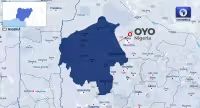
Governor Seyi Makinde said seven teachers and pupils were taken, including very young children between the ages of 2 and 3. Police said the attack happened at Community High School between 8:00 and 9:00 a.m., and that the school’s principal, Rachael Alamu, was among those taken away. The dead teacher, Adesiyan Adebgoye, has since been buried.
The abductions matter far beyond Oyo because they point to a threat that security officials now describe as moving south. President Bola Tinubu has ordered security agencies to move quickly to free the children and teachers, while Major General Michael Onoja said the recent wave of kidnappings were terrorist operations launched by fighters pushed out of other parts of the country by military pressure. That assessment matches the fear among analysts that militants have been forced to scatter from the northeast and are now looking for new ground elsewhere.


Lawyer and security commentator Audu Bulama Bukarti went further, saying that if the Nigerian military has confirmed Boko Haram was behind the attack, then no one was more likely to have done it than an emissary of the group’s late leader, Abubakar Shekau. Bukarti said a man known as Sadiqu was one of seven people Shekau sent from the northeast to the north-central region in 2014 to seek alliances with Darul Islam fighters. He said Sadiqu, originally from Borno state, now leads a Boko Haram faction in that area.
Bukarti linked that faction to camps in Alawa forest and later Kainji forest in Niger state, saying fighters from there could reach Oyo to carry out attacks. He also said, in his words, that “Sadiqu ne ya kai harin jirgin ƙasan Abuja zuwa Kaduna a 2022,” tying the same figure to the 2022 Abuja-Kaduna train attack. On that reading, the Oyo abductions are not an isolated strike but part of a wider spread of violence that has moved with the militants themselves.
The unanswered question is no longer whether the threat can travel. It already has. The question now is whether Nigerian forces can find the children and teachers before the pattern of attacks on schools in the south becomes a larger and more lasting danger.