




Donald Trump said on Saturday he had cancelled a planned trip to Islamabad by his representatives Jared Kushner and Steve Witkoff, posting that he had called off the visit and declaring in a separate message: "I just cancelled the trip of my representatives going is Islamabad, Pakistan, to meet with the Iranians," and that "we have all the cards, they have none! If they want to talk, all they have to do is call!!!"
The White House had said on Friday that Kushner and Witkoff would head to Pakistan on Saturday as part of an effort to open a channel with Tehran, and a report in also said the visit was cancelled. Pakistan had been acting as a mediator: President Masoud Pezeshkian and Iranian Foreign Minister Abbas Araghchi handed what was described as a workable framework to the mediator in Islamabad on Saturday morning, and Araghchi left talks in Islamabad later that day after presenting Iran's position.
Centcom separately said U.S. forces intercepted an Iranian "shadow fleet" vessel in the Arabian Sea. The U.S. military said the M/V Sevan was carrying "billions of dollars worth of Iranian energy, oil and gas products" to foreign markets, was intercepted by a U.S. Navy helicopter and was complying with U.S. military direction to turn back to Iran under escort.
The timing sharpened the stakes. Araghchi said he was "yet to see if the US is truly serious about diplomacy" after leaving Islamabad, while Iran's president, Masoud Pezeshkian, told Pakistan's prime minister by phone that Tehran would not enter "imposed negotiations" under threats or blockade and insisted the U.S. should first remove what he called "operational obstacles," including a U.S. blockade on Iranian ports. An Iranian diplomatic source in Islamabad also told mediators Tehran would not accept "maximalist demands."
Trump posted multiple comments Saturday emphasizing force and skepticism of negotiation. He wrote that the trip was cancelled because of "Too much time wasted on traveling, too much work!" and because "tremendous infighting and confusion within their 'leadership.'" He added, "Nobody knows who is in charge, including them," repeating his earlier line that "we have all the cards, they have none! If they want to talk, all they have to do is call!!!"

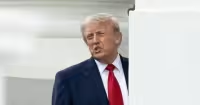
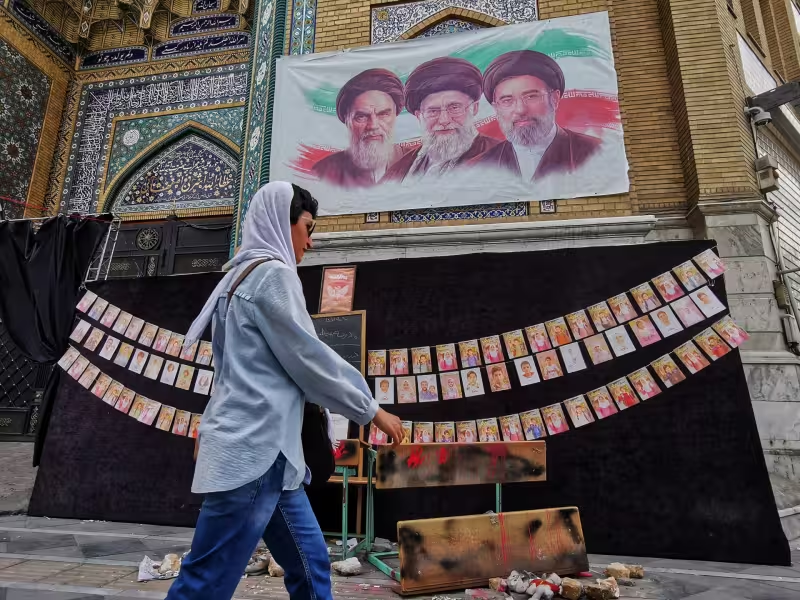
Those public barbs came after Pakistani mediators said they had received a workable framework from Tehran on Saturday morning intended to help end the two-month conflict. Iranian officials said Araghchi had put forward Iran's position on a framework to end the war before he left Islamabad.
The cancelation undercuts a diplomatic channel that had been quietly forming: Pakistan was being used as a third-party mediator between Iran and Washington, and the planned arrival of Kushner and Witkoff was the most visible U.S. move toward a mediated dialogue. The broader fighting and diplomacy have been described by intermediaries as stalled, with both sides showing little willingness to soften terms; Pakistan's role had already been put under pressure by military and naval actions in the region.
The U.S. naval interception and the public cancellation of the envoy visit expose the friction between a public, hardline American posture and a quieter push to use mediators to open talks. The U.S. military action against the M/V Sevan came as negotiators in Islamabad were still working through Iran's proposals, and Trump’s public withdrawals turned what had been a mediated effort into an explicitly political act.
For readers tracking related developments, reporting has noted rising tensions over Tehran’s nuclear program and shipping, including past coverage like Uranium claims escalate after Trump says Tehran will 'miƙa' its stockpiles ( and a prior dispatch on these canceled talks ( The broader diplomatic environment also overlaps with other domestic policy fights highlighted elsewhere (
The immediate consequence is plain: a planned U.S. mission to Islamabad meant to test whether Pakistan could bridge Tehran and Washington is off. With Araghchi skeptical that the U.S. is serious about diplomacy, Pezeshkian demanding the removal of "operational obstacles," and U.S. forces intercepting suspected shadow shipments of energy, the conditions for a negotiated pause have been weakened rather than strengthened.
This sequence makes a near-term breakthrough unlikely. Trump's decision to make the cancellation public, paired with military interdiction at sea, hands Iran a reason to dig in; Pakistan's mediator role has been publicly diminished; and the only plausible next step for American envoys would be private follow-up calls — which, in Trump’s framing, Iran could make "if they want to talk."