





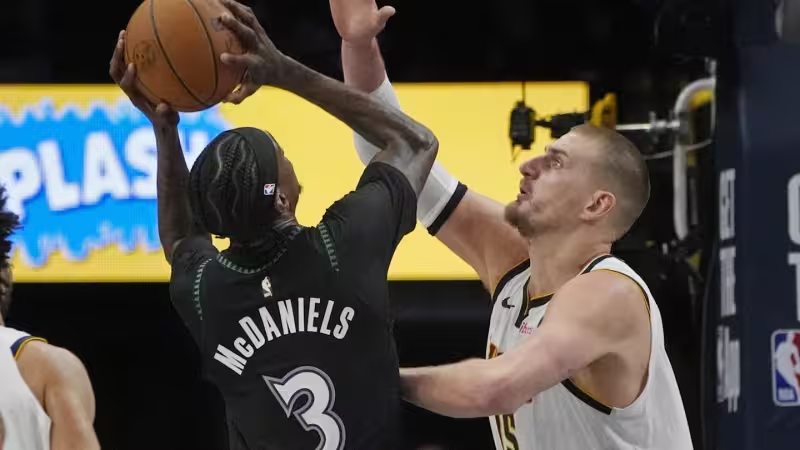
Nikola Jokic walked off the court with a season’s worth of questions after the Denver Nuggets lost 112-96 on Saturday night, falling into a 3-1 hole against the Minnesota Timberwolves in their first‑round series.
The scoreline tells the basic story: Denver managed 96 points while shooting 38 percent from the field and just 21 percent from beyond the arc. The Timberwolves led for long stretches, and after Anthony Edwards left late in the second quarter with what was assumed to be a knee hyperextension — Minnesota was up 44-39 — Minnesota outscored Denver by 21 the rest of the way.
Those numbers are the weight of this game: back‑to‑back 96‑point outputs for Denver — the Nuggets scored 96 in Game 3 as well, when they shot a season‑low 34 percent from the field and 25 percent from three — and a stingy Minnesota defense that repeatedly forced uncomfortable looks. Jokic’s own ledger from Game 3 only magnified the problem; he went 7‑for‑26 in a 113-96 loss at the Target Center on April 23, 2026, a night that handed Minnesota a 2-1 series edge before Saturday.
Context sharpens why tonight matters: Denver must now become just the 14th team in NBA history to erase a 3-1 deficit. That isn’t a prediction — it’s a simple arithmetic and historical fact Denver cannot avoid as it prepares for Game 5.



The tension in this series sits at the intersection of injury and execution. Edwards’ scary exit altered the Timberwolves’ rotation and momentum; Minnesota not only held the lead when he left, it extended that advantage by 21 points afterward. At the same time, Denver’s offense has slipped into a pattern of low efficiency. Jokic himself said Minnesota’s length and defensive activity made the Nuggets take tough shots and add extra moves to them, and he conceded the club opened the game badly, which cascaded into an offensive slog.
Coach David Adelman downplayed the idea of desperate shot selection, saying many of the attempts were sound but that Jokic and others simply had off nights — part of the variability of playoff basketball. Jamal Murray echoed that sentiment, calling the shooting a rare outlier for Jokic and the group and insisting the team is not worried about long‑term damage from one bad night.
Still, words and reassurances collide with the ledger: two consecutive 96‑point outputs, 38 percent shooting in Game 4, 21 percent from three, and a 3-1 deficit. Those facts force a strategic, immediate question Denver must answer: can they generate cleaner looks against Minnesota’s length without relying on a single player to override a coordinated defense?
What comes next is stark. Game 5 looms as a must‑win if the Nuggets are to keep any realistic path alive toward reversing the series. The practical consequence — the one outcome that changes everything — is simple: lose again and the Timberwolves will close out the first round; win and Denver keeps the improbable comeback dream alive.
For Jokic and his teammates the moment is concrete, not rhetorical. They have produced two identical point totals across consecutive losses and watched an opponent turn a late injury into a 21‑point run. If Denver is to avoid becoming another historical footnote, the answer will have to be shown on the floor in Game 5, not explained off it.