



Kane Parsons’s feature Backrooms is tracking to open around $20 million in the May 29–31 weekend, and the film had just finished post-production the morning that the early box-office estimates arrived.
The film, directed by Parsons and being released through A24, stars Chiwetel Ejiofor, Renate Reinsve and Mark Duplass, and follows a therapist who must venture into another dimension after her patient disappears. Financed by Chernin Entertainment for under $10 million, Backrooms will reach theaters on May 29, 2026 without any premium large-format or IMAX screens attached to its launch.
The headline number — roughly $20 million — is the single fact that explains why this project is suddenly more than a fan curiosity: it would be a sizable opening for a film made for less than $10 million and lacking PLF muscle, and it arrives after the recent wave of attention around Lucasfilm/Disney’s Star Wars: Mandalorian and Grogu.
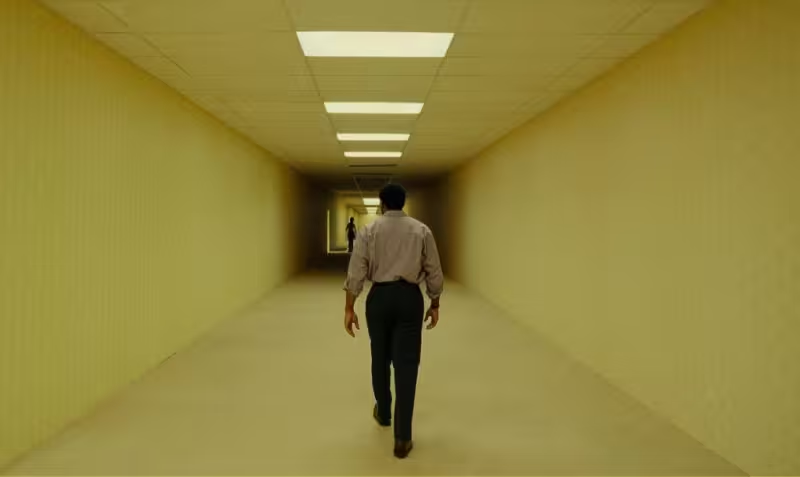
The movie’s commercial case rests on a decade of internet virality. The Backrooms concept began in 2019 on 4chan and spread across Reddit and fan wikis, evolved into games on Roblox and Minecraft, and was reshaped by Parsons into a found‑footage cinematic universe in 2022 using tools such as Blender and Unreal Engine. A related YouTube series, The Backrooms: Found Footage, drew about 190 million views, giving the property an unusually deep, young fan base before a single studio camera rolled.
That existing audience is crucial. Industry observers say the IP carries a particular momentum among under‑25 viewers who already know the world and language of the Backrooms, and who treat the property as something made by and for them. Parsons’s leap from viral creator to feature director brings both credibility and risk: he inherits a built‑in constituency but also the expectations of fans who have consumed the IP in short, immersive bursts online.
The contradiction is the story’s tension. Backrooms carries household names — Ejiofor and Reinsve give it star heft — yet it is being pushed into multiplexes without the extra-ticket-price formats studios typically use to juice opening weekends. That choice lowers the ceiling for per‑theater earnings but also concentrates risk: if the young core audience turns up in large numbers, the film can be profitable quickly; if it doesn’t, there are fewer premium avenues to make up the difference.
Another uncertainty is how much the film’s momentum depends on the fandom versus wider discovery. The property’s path from anonymous creepypasta to a theatrical release has been unusually direct: internet virality, a 2022 technical reworking into found footage, and a YouTube presence that proved audience appetite. Now it must translate that attention into box office dollars and, beyond that, into cultural surface area in a crowded release period.
If the tracking holds, Backrooms will be a textbook example of low-budget upside: a $20 million opening against a production cost under $10 million, without PLF or IMAX, tilts the math toward early profitability and vindicates the gamble to adapt an internet-born IP on modest means. For Parsons and his cast, the likely outcome is not merely a successful weekend but proof that digital native horror can cross into theaters and pay off — a practical answer to whether a grassroots, found‑footage phenomenon can become a mainstream box‑office success.