




Anthropic on Thursday launched Claude for Small Business, a ready-to-run package that embeds its Claude assistant inside the tools small companies already use and ships with prebuilt workflows to handle routine back-office tasks.
Daniela Amodei, Anthropic’s co‑founder, said the goal is practical: "Small businesses make up nearly half the American economy, but they've never had the resources of bigger companies. AI is the first technology that can finally close that gap, which is why we're launching Claude for Small Business, alongside training and partnerships to make sure AI shows up for the entrepreneurs and communities who need it most. Claude for Small Business runs inside the tools owners already rely on, like QuickBooks, PayPal, and HubSpot, and takes on the work that piles up after hours, like planning payroll, chasing invoices, or kicking off a marketing project. People run the business, and Claude helps take the late-night work off their plates."
The package arrives with measurable scale: Anthropic said it shipped Claude for Small Business with 15 ready-to-run agentic workflows and 15 skills focused on the repeatable tasks owners said slow them down most. The product can be installed as a toggle inside Claude Cowork and connects to seven named platforms — Intuit QuickBooks, PayPal, HubSpot, Canva, Docusign, Google Workspace and Microsoft 365 — so the assistant can plan payroll, close the month, run a sales campaign or chase invoices without forcing users to hop between separate tools.
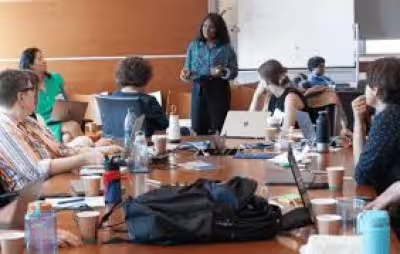
Anthropic also announced a training partnership with PayPal, launching AI Fluency for Small Business, a free online course taught by owners who have already built AI into their operations. The company named Prospect Butcher Co. in Brooklyn and MAKS TIPM Rebuilders in California as instructors for the program, using practitioners rather than technologists to show how workflows and connectors play out in a real shop.
The timing is pointed. Anthropic said small businesses account for 44% of U.S. GDP and employ nearly half the private‑sector workforce, yet small business adoption of AI has lagged behind larger enterprises. The company framed the new bundle as an effort to move AI beyond experimental chat windows and into day‑to‑day processes that determine whether a smaller firm can compete on time and margins.

The launch leans on scale and convenience: prebuilt connectors, agentic workflows and a toggle inside an existing workspace lower the technical and administrative bar for deployment. Anthropic said the 15 workflows span finance, operations, sales, marketing, HR and customer service — the same categories where small owners report the most friction — and the 15 skills are built on tasks owners already named as time sinks.
But the package surfaces an obvious tension. Anthropic itself reported that half of the small business owners in its survey named data security as their single biggest hesitation about AI. Connecting bookkeeping, payments and CRM systems to an external assistant answers the speed problem while raising the very risk that owners flagged: more integration means more moving parts—and more places data travels. Anthropic is pairing product changes with training and a public‑facing pitch to calm those concerns, but the gap between convenience and security will be the practical test of whether these tools get widely adopted.
Anthropic said the PayPal partnership and the AI Fluency course are meant to address that hesitation by showing owners how AI fits into established workflows and by putting peers from Prospect Butcher Co. and MAKS TIPM Rebuilders in instructional roles. Whether demonstrations and connectors will be enough to overcome the security worries that half of owners say are their main barrier is the unanswered operational question embedded in the launch.
This is not a theoretical move. By embedding Claude inside QuickBooks, PayPal, HubSpot and other everyday tools and by shipping 15 agentic workflows, Anthropic has turned a product release into a bet: that lowering the technical lift and offering shop‑level training will move small businesses from curiosity to regular use. If it works, the consequence is simple and large — more small firms will offload late‑night bookkeeping and campaign follow‑ups to software rather than to stretched owners. If it doesn't, adoption will stall where it already has: at the intersection of usefulness and trust.
For now, Anthropic has done what small owners have long asked for in practice: tools that sit where they work and training from peers to make adoption less mysterious. The company is betting that a package of connectors, workflows and education can do what previous AI rollouts did not—push the assistant out of the chat window and into the daily grind of running a business.