



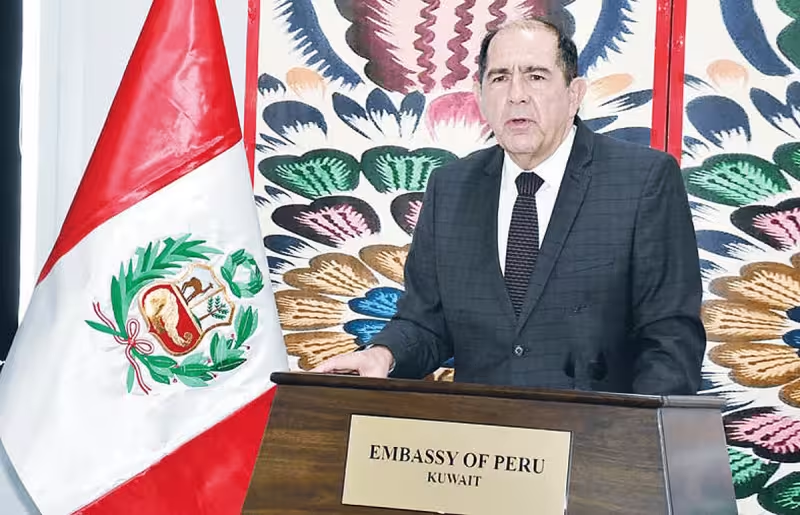
Peruvian Ambassador H.E. Carlos Enrique Tomas Jimenez Gil-Fortoul on Eid Al-Adha extended wishes for Kuwait’s continued peace and prosperity, praising the country’s responsible management during regional crises and reaffirming strong bilateral relations between Peru and Kuwait.
The message came as part of a broader wave of diplomatic greetings: on May 26 several ambassadors and heads of diplomatic missions in Kuwait conveyed Eid Al-Adha congratulations to Kuwaiti leaders. Among the messages reported for the holiday, His Highness the Crown Prince Sheikh Sabah Khaled Al-Hamad Al-Sabah received congratulatory notes from senior Kuwaiti leaders and officials while foreign envoys, including the Peruvian ambassador, offered their good wishes.
Carlos Enrique Tomas Jimenez Gil-Fortoul’s remarks emphasized two points that repeatedly surfaced in the diplomatic exchanges: praise for Kuwait’s steadiness in the face of regional crises and a pledge to maintain close ties. The ambassador’s statement—singling out Kuwait’s responsible handling of difficult circumstances—also contained a clear diplomatic line: reaffirmation of strong bilateral relations between Peru and Kuwait alongside the traditional happy eid al adha wishes for peace and prosperity.
Context for those remarks is straightforward. Eid Al-Adha prompted a flurry of congratulatory messages from Kuwaiti leaders and foreign diplomats, a ritual that this year doubled as a stage for underscoring security, stability and humanitarian standing. In that light, the Peruvian ambassador’s praise and his note on bilateral relations fit a familiar pattern: holidays provide opportunities for public diplomacy and for leaders to frame their countries’ relationships in positive terms.

The notes of praise contained a strain of tension, however. Commending Kuwait’s responsible management during regional crises both acknowledges the existence of those crises and sets up a contrast between public confidence and private anxiety. Diplomatic greetings are, by design, ceremonial; they smooth over problems and emphasize continuity. Yet the ambassador’s explicit reference to regional crises highlights why such reassurances matter now—because the stability they describe cannot be taken for granted.
That tension matters beyond ceremony. When an ambassador uses a holiday message to pair congratulations with concrete praise for governance during crises and to affirm bilateral ties, the language signals priorities. For Lima and Kuwait, those priorities now include maintaining the channels of diplomacy that make cooperation possible when regional volatility spikes. The Peruvian ambassador’s statement did not map out policy steps, but it put the relationship on record in public terms during a moment of high symbolic visibility.
Diplomacy on holidays tends to be short on detail and long on implication. What the Peruvian message did most plainly was twofold: it extended customary Eid goodwill and it publicly cemented an assurance of ongoing cooperation between Peru and Kuwait. That combination—ceremonial blessing plus an affirmation of ties—will frame how both capitals refer back to this moment, and it makes clear what comes next: more routine diplomatic engagement grounded in the goodwill voiced today.
For now, Carlos Enrique Tomas Jimenez Gil-Fortoul’s Eid Al-Adha message stands as a direct, public affirmation of the relationship between Peru and Kuwait and as a reminder that diplomatic ties are still an active tool for sustaining peace and partnership amid regional uncertainty.