



Ayatollah Ali Khamenei broke his silence and vowed that the United States will not have military bases in the Middle East, releasing a Hajj message that mixed religious language with revolutionary memory.
The message, issued on the occasion of the pilgrimage, opened with Khamenei’s declaration that, "This year’s Hajj season has once again arrived and the pilgrims of the Islamic Ummah have worn the ihram of servitude," and it included the exclamation, "Yes, Allahu Akbar (God is the greatest) …"
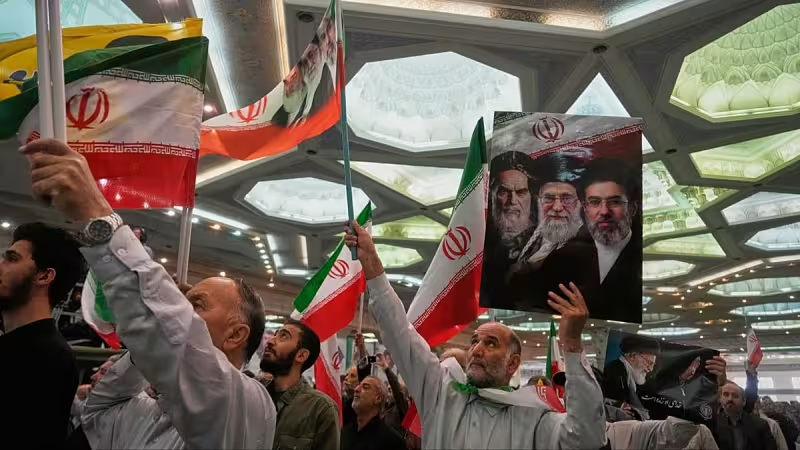
Khamenei went beyond liturgical phrasing. He cast the Iranian nation’s present stance as rooted in the Islamic Revolution, saying the Iranian nation stepped onto "the path of this migration at the miqat of the Islamic Revolution" and noting that "the Muslim nation of Iran rose up 47 years ago and toppled the Pahlavi regime." He also recalled that, after "the Ba'athist regime of Saddam invaded Iran's soil," the country endured the "8-Year Sacred Defense."
The numeric anchors in the message — 47 years and the 8-Year Sacred Defense — are the strongest signals Khamenei offered of a narrative that ties religious observance to a history of resistance. Those references frame the Hajj not only as a spiritual obligation but as a moment to remember revolutionary rupture and wartime endurance.


Context for the tone of the address is explicit in the full message posted on Khamenei.ir: it is a Hajj message that interweaves religious exhortation and revolutionary themes, linking pilgrimage rituals to political resistance and to a rejection of domination. The document pairs devotional phrases such as the ihram and the pilgrimage’s rituals with reminders of Iran’s overthrow of the Pahlavi monarchy and the later conflict with Saddam’s Ba'athist regime.
The friction in the address is sharp because Hajj is primarily a religious journey meant to unite Muslims across political divides, while Khamenei’s vow about U.S. military bases is a geopolitical claim. He "broke his silence" to make that claim within a religious statement, folding geopolitics into a sermon on sacred obligations and national history. That blend raises a question that the document itself does not resolve: whether a pilgrimage appeal framed as servitude to God will be used to justify specific state actions aimed at expelling foreign military presence.
For readers trying to parse immediate implications, the message supplies clear lines of authority and symbolism but no operational detail. It reiterates a long-standing narrative in which Iran’s revolutionary identity and memories of invasion — the Pahlavi overthrow and the subsequent 8-Year Sacred Defense after Saddam’s invasion — serve as moral and historical grounds for resisting outside military footprints. What the message does not do is outline concrete steps or timelines for how that vow would be pursued.
The single most consequential unanswered question now is whether Khamenei’s vow will be translated into concrete policy or campaigns that aim to remove U.S. bases from the region, and if so, how Tehran intends to pursue that objective while framing it within the religious symbolism of Hajj. The Hajj message ties devotion to past struggle; the next move that answers that vow will determine if it remains a rhetorical posture or becomes a guiding policy.