


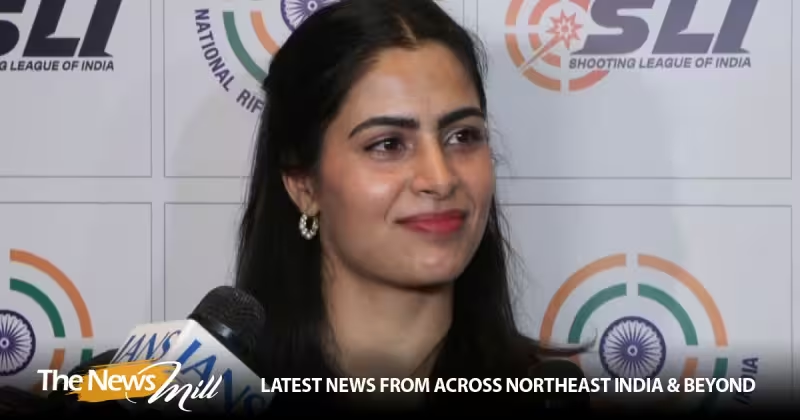
Manu Bhaker said she is fixing her immediate attention on two big targets: the Asian Games in Japan this September and the World Championships in Doha in November, remarks she made while speaking at celebrations for 75 years of the National Rifle Association of India.
Bhaker told the gathering that the Asian Games run from September 19 to October 4 and the World Championships will be held in Doha, Qatar, from November 1 to 15, and that her team has laid out a specific training plan with her coach to be ready for both competitions. She said the preparation has been mapped out, the logistics are in place, and she expects to perform well.
The numbers underline why those events matter for Bhaker and for Indian shooting: the Asian Games and the Doha World Championships are major international calendars that fall close together at the end of the year, leaving little margin for error in training and selection. At the same time, the NRAI marked its 75 years with a series of announcements aimed at widening the sport’s base, including an app to streamline administration and a pledge to take up 750,000 athletes, some children, to try shooting.
Bhaker traced her rise back to a single, defining moment. She recalled that her first major breakthrough came at the 2018 Commonwealth Games in Australia, where she won gold in the 10m air pistol event. That milestone, she said, set the course for her career and remains the benchmark she measures herself against as she prepares for the year’s two biggest targets.
Her comments mixed personal gratitude with a larger institutional message: Bhaker credited the NRAI for the support system behind Indian shooters. She said when a federation works well it supports and backs up athletes, and that the current arrangement feels “very comfortable” and “liberating.” She tied that backing to the broader growth of the sport, noting that in the last 10 to 15 years national competitions have seen a dramatic rise in participation across rifle, pistol and shotgun events.
Even as she praised that expansion, Bhaker acknowledged a painful gap in the sport’s competition calendar: she noted that after her 2018 success, shooting did not feature again at the Commonwealth Games for a period, a loss she described as sad. That discontinuity sharpens the importance of the NRAI announcement that India will host the Commonwealth Games in 2030 in Ahmedabad, which Bhaker said will bring the crowd and arena home and should boost Indian performance.
The program the NRAI unveiled at its 75-year celebrations is explicitly aimed at turning that potential into participation: an app to make administration easier, and the mass outreach to 750,000 young athletes designed to introduce children to shooting. Bhaker called those steps “a very good initiative” and said they point to a “very, very bright future” for the sport in India.
The tension in Bhaker's account is plain. She described a sport that has surged in numbers and institutional ambition while also enduring gaps in major event access; she wants both better funding and stable competition opportunities. Her answer is practical: focused preparation for the Asian Games and World Championships, trust in the NRAI’s support system, and optimism that nationwide development will raise standards and depth over the next decade.
Bhaker left the stage framing what's next with quiet confidence: she and her coach have a plan, the calendar is clear, and the NRAI's recent moves aim to deepen the talent pool ahead of Ahmedabad 2030. If those pieces hold, Bhaker will enter Japan in September and Doha in November as a clearer measure of whether institutional promises translate into medals.
Meanwhile, conversations about sport and politics continue elsewhere on the site, as in Emmanuel Eboue: Abdul Ningi says PDP can still win Bauchi State in 2027 —


