




In Lisbon on April 21, President Luiz Inácio Lula da Silva told a joint news conference with Portugal’s prime minister that "Portugal pode ser a grande porta de entrada dos interesses empresariais brasileiros na Europa." The remark came as he pressed for deeper economic ties focused on investment and productive integration between the two countries.
Lula spelled out the logic: "É muito importante que parte das coisas que o Brasil vai negociar com a União Europeia possa ser construída aqui em Portugal," he said, and added that the Mercosul‑EU agreement creates a more favorable environment for expanding investments and diversifying economic relations. His comments arrive with the Acordo Mercosul‑União Europeia set to enter into force on 1 de maio, a timetable the Brazilian president invoked to underline the urgency of concrete projects.
The numbers behind the pitch matter in practical terms. According to official Portuguese government data from 2024, about 485 mil cidadãos brasileiros were regularized in Portugal, making the Brazilian community the largest of foreign residents in the country. Lula used that human and commercial link to illustrate opportunities in sectors he singled out for cooperation: "E a gente pode repetir, primeiro‑ministro, vários acontecimentos como a Embraer aqui em Portugal. A Embraer é a demonstração mais bem‑sucedida de uma empresa brasileira que está aqui ajudando a construir coisas em Portugal." He cited aerospace alongside science, technology and innovation as areas where Brazil and Portugal are already advancing together.
That weight of people, commerce and corporate ties framed a diplomatic encounter at Palácio de Belém. António José Seguro and Margarida Maldonado Freitas received Lula da Silva and Rosângela da Silva on April 21; it was the first reception of the current President of the Portuguese Republic for the Brazilian presidential couple. The meeting, officials said, covered issues tied to the communities in both countries, the economic relationship and promotion of the Portuguese language — a set of topics Lula repeatedly linked to a broader multilateral agenda.
"Todo mundo sabe que eu sou defensor do multilateralismo. Todo mundo sabe que eu sou inimigo do unilateralismo e do protecionismo," Lula told reporters, framing the bilateral push as part of a wider rejection of protectionist reflexes. He expanded on the practical side of that idea with a line about trade: "O comércio internacional só dá resultado se você não quiser sufocar o teu cliente. É preciso que o cliente sobreviva para ser seu cliente. E é isso que nós queremos: que a nossa relação com a União Europeia esteja o mais sofisticada possível."
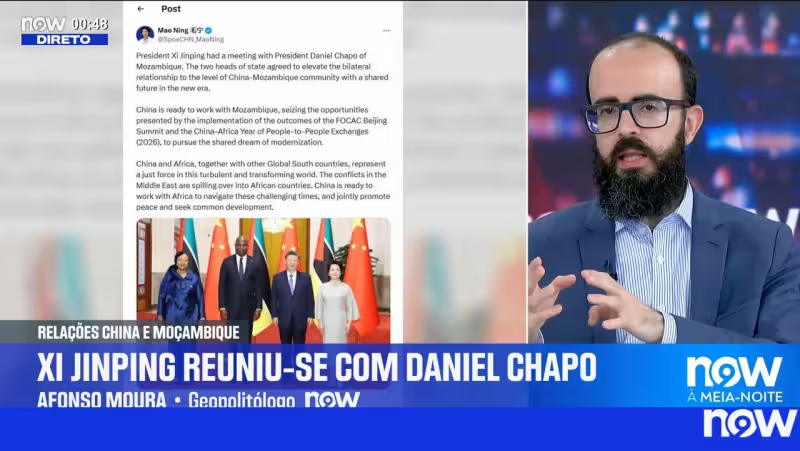
Not everyone treated the visit as only a commercial opportunity. The geopolitologist Afonso Moura, speaking on NOW, said institutions in Portugal "fazem muito bem em receber Lula da Silva e fizeram muito mal em não receber Jair Bolsonaro," and added that "o Estado tem de estar acima dos governos." His comments pointed to an underlying political tension: bilateral economic outreach sits alongside domestic debates about how Portuguese institutions handle foreign leaders.
That gap — between an eager commercial agenda and the politics of reception — is the central friction of the moment. Lula called the relationship "o seu melhor momento de relação," arguing that historical and cultural ties make Portugal a natural hub. Yet the test he set is concrete: will investment and production integration actually flow through Portugal as the Mercosul‑EU pact becomes active on May 1?
The most consequential near‑term question is whether the agreement’s entry into force will trigger the projects Lula forecast. If companies and capital begin to locate production or operations in Portugal, his claim that the country can be the "grande porta de entrada" for Brazilian business in Europe will be vindicated. If not, the visit will be remembered more for rhetoric than results.