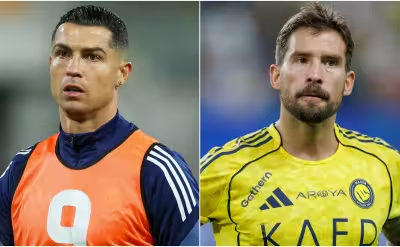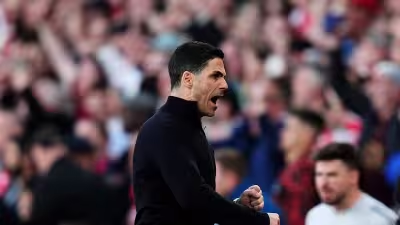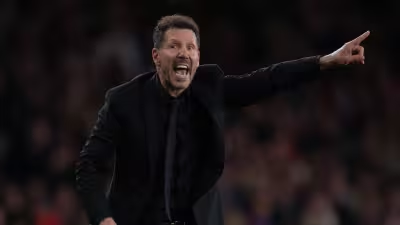





Giuliano Simeone is part of Atlético Madrid’s Champions League charge this week as his father, Diego Simeone, turned 56 on Tuesday and prepares to lead the club into his fourth European Cup semi-final as coach.
Diego Simeone celebrated his birthday with family and with a squad that has carried Atlético back to the last four of Europe for only the seventh time in the club’s history, and the club’s first semi-final in nine years. "Buah! You can’t imagine how good it is to be in the four best teams in Europe," the coach said after the draw, and on his birthday he added: "I have no birthday wish" and described the day as "just pure gratitude to be able to be with my three sons on my birthday, with my two daughters, my mum, my wife, my lifelong friends."
The numbers underline why this matters now: Diego has been at Atlético for almost 20 years, has taken them to a fourth European Cup semi-final as coach, and Atlético as a club are into a seventh semi-final overall. For the player in the dressing room who once stood by the bench, the statistic that stands out is Giuliano’s work rate — he covers an average of 11.4 kilometers per match — the kind of engine a coach who built his reputation on intensity values in Europe’s knockout ties.
Giuliano’s route to this moment is visible in the club’s memory. Born in Italy in December 2002 and raised in Argentina with his elder brothers Giovanni and Gianluca, he was carried across the Vicente Calderón in December 2004 when he was two. He spent years as a ballboy and beside the bench; he raced along the touchline in a white bib and leaped into his father’s arms after a derby victory in January 2015. He was sent on loan to Alavés before earning a spot in the first-team dressing room, and as a hybrid forward his role has been shaped by those club ties and years inside Atlético’s routines.


Those routines run deep. Diego was the captain who won the double for Atlético Madrid and later coached the club to a league title 18 years after the previous one. The family’s presence at matches has been a steady motif: scarves draped around a room after a Copa del Rey triumph in 2013, Diego caught on camera speaking excitedly during Europa League title celebrations in 2012. For giuliano simeone, the arc has been from fan, to ballboy, to player with a locker by the same bench he once stood behind.
The background contains a friction that follows every football family story. An early moment captures it: in December 2011, Diego stopped in a cafe in Mar del Plata and asked eight-year-old Giuliano what he thought about coaching Radamel Falcao. Diego’s incredulous reaction — "You’re going to coach [Radamel] Falcao?!" — was followed by the warning, "But … if it goes well, you won’t come back." Observers have framed Giuliano’s rise as a shift from being the coach’s son to earning his place on merit; the loan to Alavés and the mileage he logs on matchdays are the clearest counters to any suggestion of favoritism.
Giuliano himself has been candid about the early pull of the first team. "It was crazy seeing the players up close," he said of those childhood years at Atlético, and later: "I always thought: ‘Imagine being out there; that would be mad.’" His idolization moved from Radamel Falcao to Antoine Griezmann as his game developed, a switch that mirrors the team’s evolution and the tactical demands now placed on him.
The question now is simple and decisive: can the player who once clung to his father’s neck in a derby become one of the decisive figures on Europe’s biggest night for Atlético in a decade at the Metropolitano? If Giuliano turns the 11.4 kilometers he covers into the kinds of defining actions that settle semi-finals, he will have made the clean break from being the coach’s son to being judged on the only thing that ultimately matters in Champions League knockout football — what he delivers on the pitch.